
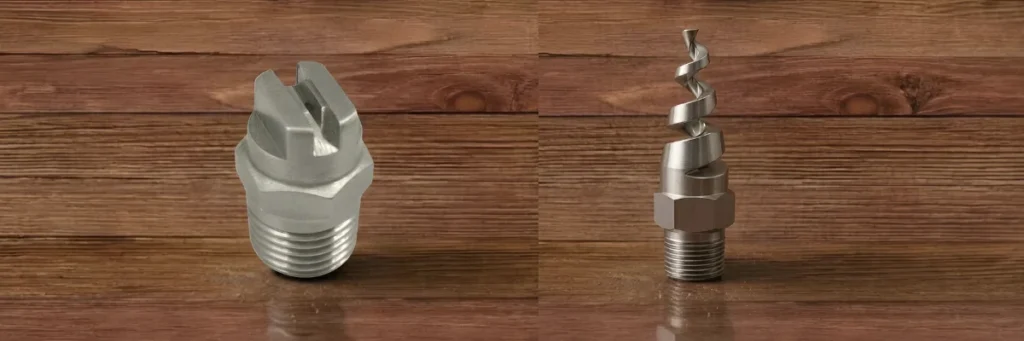
Choosing the right spray nozzle is important for proper spray coverage, cleaning performance, cooling efficiency, dust suppression, and water distribution. Two commonly used industrial spray nozzles are flat fan nozzles and full cone nozzles.
Both nozzles are useful, but they are designed for different spray patterns and applications. A flat fan nozzle gives a straight, fan-shaped spray, while a full cone nozzle gives a round, filled spray pattern.
This guide explains the main differences, applications, benefits, and selection points to help you choose the right nozzle.
What Is a Flat Fan Nozzle?
A flat fan nozzle produces a thin, fan-shaped spray pattern. The liquid spreads in a straight line, making it suitable for surface cleaning, washing, rinsing, coating, and controlled spraying.
Flat fan nozzles are commonly used where the spray needs to cover a fixed width or target a specific surface.
Common Uses of Flat Fan Nozzles
Flat fan nozzles are used for:
- Conveyor belt washing
- Surface cleaning
- Parts washing machines
- Vehicle washing systems
- Chemical spraying
- Cooling of flat surfaces
- Coating and pretreatment lines
- Screen washing
- Food processing wash systems
Benefits of Flat Fan Nozzles
- Provides controlled spray coverage
- Gives good cleaning impact
- Suitable for surface washing and rinsing
- Easy to install in rows for wide coverage
- Useful for precise spray direction
- Available in different spray angles and flow rates
What Is a Full Cone Nozzle?
A full cone nozzle produces a round spray pattern filled with droplets. It covers the complete circular area, making it suitable for cooling, dust suppression, gas scrubbing, and liquid distribution.
Full cone nozzles are commonly selected when the application requires wider area coverage.
Common Uses of Full Cone Nozzles
Full cone nozzles are used for:
- Dust suppression systems
- Gas cooling systems
- Gas scrubbing towers
- Chemical spraying
- Fire protection systems
- Foam control
- Material cooling
- Vessel washing
- Mining and cement plant applications
Benefits of Full Cone Nozzles
- Provides full circular spray coverage
- Suitable for wide-area liquid distribution
- Good for dust control and cooling
- Handles medium to high flow requirements
- Useful in process industries
- Available in standard and wide-angle designs
Flat Fan vs Full Cone Nozzle: Main Difference
The main difference between a flat fan nozzle and a full cone nozzle is the spray pattern.
| Point | Flat Fan Nozzle | Full Cone Nozzle |
|---|---|---|
| Spray Pattern | Flat, fan-shaped spray | Round, filled cone spray |
| Coverage Area | Line or rectangular coverage | Circular coverage |
| Best For | Washing, rinsing, coating | Cooling, dust control, gas scrubbing |
| Spray Impact | Higher impact on a narrow area | Medium impact over a wider area |
| Distribution | Uniform across a line | Uniform across a circular area |
| Installation | Often arranged in rows | Used individually or in groups |
| Spray Direction | More focused | More spread out |
When Should You Choose a Flat Fan Nozzle?
Choose a flat fan nozzle when your application requires controlled spray over a surface, line, or moving object.
Flat fan nozzles are best for applications such as washing, rinsing, surface treatment, conveyor cleaning, and controlled chemical spraying.
Choose Flat Fan Nozzle If:
- You need a straight-line spray pattern
- You want to clean a surface
- You need higher impact in a selected area
- You are spraying conveyor belts, sheets, plates, or parts
- You need multiple nozzles arranged side by side
- You want controlled spray direction
Example
For a parts washing machine, flat fan nozzles are usually preferred because they spray water or cleaning liquid directly onto the part surface with good impact and controlled coverage.
When Should You Choose a Full Cone Nozzle?
Choose a full cone nozzle when your application requires circular spray coverage or liquid distribution over a wider area.
Full cone nozzles are commonly used in dust suppression, cooling, gas scrubbing, and process applications.
Choose Full Cone Nozzle If:
- You need round spray coverage
- You want even liquid distribution
- You are spraying into a chamber, duct, tower, or open area
- You need dust suppression or cooling
- You require medium to high flow coverage
- You want to cover a wide area with droplets
Example
For a coal handling dust suppression system, full cone nozzles are often used where water needs to be distributed over falling material, transfer points, hoppers, or stockyard areas.
Which Nozzle Is Better for Dust Suppression?
For dust suppression, the right nozzle depends on the dust source and spray location.
A full cone nozzle is useful when water needs to cover a wider area or falling material. It is commonly used in mining, cement, coal handling, and bulk material handling plants.
A flat fan nozzle is useful when dust is generated along a narrow belt, chute opening, screen, or specific transfer point where a directed spray is required.
For better dust control, also check droplet size, pressure, spray angle, water flow, and nozzle position.
Which Nozzle Is Better for Cleaning and Washing?
For cleaning and washing applications, flat fan nozzles are usually preferred.
Flat fan nozzles provide a stronger and more focused spray impact on the surface. They are useful for removing dust, dirt, oil, loose particles, and process residues from parts, belts, containers, and equipment surfaces.
Full cone nozzles can also be used for general washing, but they are better when the goal is liquid distribution rather than high-impact surface cleaning.
Which Nozzle Uses More Water?
Water usage depends on flow rate, pressure, spray angle, and orifice size, not only on the nozzle type.
In many applications, flat fan nozzles are selected for controlled spraying on a defined area. Full cone nozzles are selected for wider coverage and may require higher flow depending on the application.
To reduce water consumption, select the nozzle based on actual coverage requirement, pressure, and process need.
FAQs: Flat Fan Nozzle vs Full Cone Nozzle
1. What is the difference between flat fan nozzle and full cone nozzle?
A flat fan nozzle produces a flat, fan-shaped spray pattern. A full cone nozzle produces a round, filled cone spray pattern. The main difference is the spray shape and coverage area.
2. Which spray pattern does a flat fan nozzle produce?
A flat fan nozzle produces a thin, flat sheet spray. The spray spreads in a straight line and covers a line or rectangular area.
3. Which spray pattern does a full cone nozzle produce?
A full cone nozzle produces a round, filled spray pattern. The spray covers the complete circular area with droplets.
4. When should I choose a flat fan nozzle?
Choose a flat fan nozzle when you need controlled line coverage, focused spray direction, or spraying over a fixed surface width.
5. When should I choose a full cone nozzle?
Choose a full cone nozzle when you need circular spray coverage, wider liquid distribution, or spray coverage over an open area.
6. Which nozzle gives more focused spray?
A flat fan nozzle gives more focused spray because it directs liquid in a flat line pattern. It is suitable when the spray needs to hit a specific area.
7. Which nozzle gives wider area coverage?
A full cone nozzle usually gives wider area coverage because it distributes liquid in a round, filled pattern.
8. Which nozzle has higher spray impact?
A flat fan nozzle generally gives higher spray impact in a narrow area. A full cone nozzle spreads the spray over a wider circular area, so the impact is more distributed.
9. Can both flat fan and full cone nozzles be used for industrial applications?
Yes, both nozzle types are used in industrial applications. The correct choice depends on spray pattern, coverage area, flow rate, pressure, droplet size, and installation position.
10. Does flow rate depend on nozzle type?
Flow rate depends on the nozzle orifice size, operating pressure, and nozzle design. Both flat fan and full cone nozzles are available in different flow capacities.
11. Does spray angle matter when choosing these nozzles?
Yes, spray angle is important. A wider spray angle covers more area, while a narrow spray angle gives more concentrated spray coverage.
12. Which materials are available for flat fan and full cone nozzles?
Flat fan and full cone nozzles are commonly available in brass, SS304, SS316, plastic, and special alloy materials. The material should be selected based on liquid type, temperature, pressure, and corrosion resistance.
13. Can flat fan and full cone nozzles be used together?
Yes, both nozzles can be used in the same system when different spray patterns are needed. For example, one area may need focused line spraying, while another area may need circular coverage.
14. How do I select the right nozzle?
To select the right nozzle, check the required spray pattern, coverage area, operating pressure, flow rate, spray angle, droplet size, liquid type, and nozzle material.
15. Which nozzle is better: flat fan or full cone?
Neither nozzle is better for every application. A flat fan nozzle is better for line coverage and focused spraying. A full cone nozzle is better for circular coverage and wider liquid distribution.