
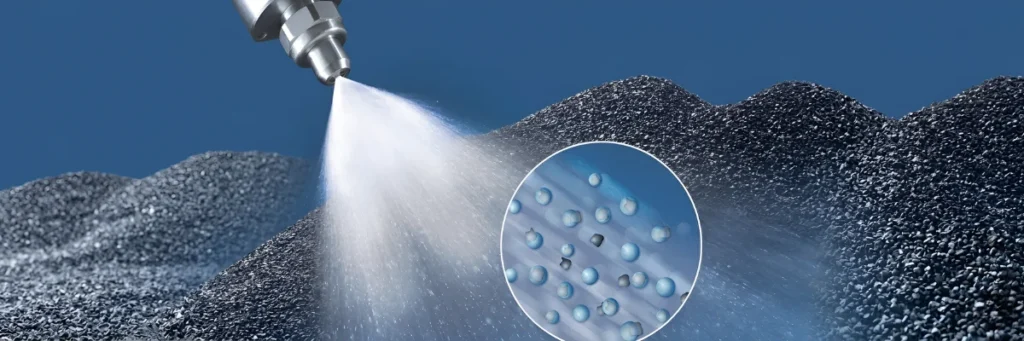
Dust suppression is not only about spraying water on dust. The droplet size produced by the spray nozzle plays a major role in how effectively dust is controlled.
If the droplets are too large, they may fall quickly and fail to capture fine airborne dust. If the droplets are too small, they may drift away with air or wind before reaching the dust source.
The correct droplet size helps water droplets collide with dust particles, make them heavier, and settle them down. This improves dust control, reduces water wastage, prevents over-wetting, and improves overall dust suppression system performance.
As a spray nozzle manufacturer, we recommend selecting dust suppression nozzles based on dust particle size, application area, spray pressure, water quality, wind condition, and required droplet size.
This blog explains why droplet size matters in dust suppression and how to choose the right nozzle for better dust control in industrial applications.
Droplet Size Comparison Table
| Droplet Size | Best Suitable For | Main Benefit | Possible Problem |
|---|---|---|---|
| Fine droplets | Airborne fine dust, dry fog, misting | Better contact with fine dust particles | Can drift in wind |
| Medium droplets | General dust control, material wetting | Balanced dust control and wetting | May not capture very fine dust effectively |
| Large droplets | Surface wetting, roads, stockpiles | Good wetting and less drift | May fall quickly and miss airborne dust |
| Very large droplets | Heavy material wetting | Strong wetting effect | Can cause over-wetting and water wastage |
Dust Particle Size vs Droplet Size
For effective dust suppression, the droplet size should be suitable for the dust particle size.
Very fine dust particles need fine droplets because smaller droplets can collide with them more easily. Large droplets may pass through the dust cloud without capturing fine particles.
For larger dust particles or surface dust, medium or large droplets may work better because they provide enough wetting and weight to settle dust.
| Dust Type | Recommended Droplet Type | Suitable Nozzle Type |
|---|---|---|
| Fine airborne dust | Fine droplets | Fog nozzle, mist nozzle, air atomizing nozzle |
| Crusher dust | Fine to medium droplets | Fog nozzle, full cone nozzle |
| Conveyor transfer dust | Fine to medium droplets | Fog nozzle, mist nozzle, full cone nozzle |
| Road dust | Medium to large droplets | Full cone nozzle, flat fan nozzle |
| Stockpile dust | Medium droplets | Full cone nozzle, misting nozzle |
| Material wetting | Medium to large droplets | Full cone nozzle, flat fan nozzle |
Benefits of Correct Droplet Size in Dust Suppression
Choosing the correct droplet size improves dust suppression performance and reduces operating problems.
- Better dust capture: Correct droplet size improves contact between water droplets and dust particles.
- Lower water consumption: Proper droplets control dust without unnecessary water usage.
- Reduced over-wetting: The system uses only the required amount of water.
- Improved airborne dust control: Fine droplets help capture fine dust near the source.
- Better material handling: Correct moisture control reduces sticking, belt slippage, and chute blockage.
- Improved worker safety: Less airborne dust helps create a cleaner working environment.
- Better environmental control: Effective dust suppression reduces dust spread outside the plant.
- Improved equipment life: Less dust buildup can reduce wear and housekeeping issues.
- Better system efficiency: Proper droplet size improves nozzle and pump performance.
- Lower maintenance cost: Correct nozzle selection reduces clogging, over-spraying, and system issues.
How Droplet Size Affects Dust Suppression Performance
1. Fine Droplets for Airborne Dust
Fine droplets are useful when the dust is very light and airborne. These droplets can stay in the air longer and mix with dust particles.
When fine droplets collide with dust particles, the particles become heavier and settle down.
Fine droplets are commonly used in:
- Dry fog dust suppression
- Crusher dust control
- Conveyor transfer points
- Coal handling dust control
- Cement plant dust suppression
- Enclosed dust generation points
However, fine droplets can drift away in open or windy areas. They work best in enclosed or semi-enclosed locations.
2. Medium Droplets for General Dust Control
Medium droplets are useful for many industrial dust suppression applications. They provide a balance between airborne dust capture and surface wetting.
Medium droplets are commonly used in:
- Conveyor transfer points
- Hoppers
- Chutes
- Material handling areas
- Stockyards
- Open plant areas
They are suitable where the dust source is not extremely fine and some wetting is acceptable.
3. Large Droplets for Surface Wetting
Large droplets are better for wetting surfaces, roads, stockpiles, and heavy dust.
They are less affected by wind and can reach the target area more easily. However, they may not be effective for fine airborne dust because they fall quickly.
Large droplets are commonly used in:
- Road dust control
- Stockpile wetting
- Material wetting
- Open yards
- Truck unloading areas
If used incorrectly, large droplets can cause over-wetting, water wastage, and material handling problems.
Droplet Size and Nozzle Type
Different nozzle types produce different droplet sizes.
| Nozzle Type | Typical Droplet Output | Common Dust Suppression Use |
|---|---|---|
| Fog nozzle | Very fine droplets | Fine airborne dust and dry fog systems |
| Mist nozzle | Fine droplets | Misting and light dust control |
| Air atomizing nozzle | Very fine controlled droplets | Dry fog and low-wetting dust suppression |
| Full cone nozzle | Medium droplets | General dust suppression and material wetting |
| Flat fan nozzle | Medium to large droplets | Targeted dust points and surface wetting |
| Spiral nozzle | Medium droplets | Dust control where clogging risk is higher |
Nozzle selection should be based on dust type, area condition, water quality, pressure, and required wetting level.
Droplet Size and Operating Pressure
Operating pressure has a direct effect on droplet size.
In many nozzles, higher pressure produces smaller droplets. Lower pressure usually produces larger droplets.
However, higher pressure is not always better.
If pressure is too high, droplets may become too fine and drift away. If pressure is too low, droplets may become too large and fail to capture airborne dust.
The best pressure is the pressure that creates the required droplet size for the dust source and site condition.
Droplet Size and Water Usage
Correct droplet size helps reduce water consumption.
If droplets are too large, more water may be used than required. This can create wet material, sludge, belt slippage, and drainage problems.
If droplets are too fine and drift away, the system may waste water without controlling dust.
A properly selected nozzle produces droplets that reach the dust source and control dust with minimum water use.
Droplet Size and Wind Condition
Wind condition is very important in dust suppression.
Fine droplets can be carried away by wind before they reach the dust cloud. This reduces dust control efficiency.
In windy or open areas, medium or larger droplets may perform better because they have more weight and can reach the target area.
For enclosed points such as transfer chutes, crushers, and screens, fine droplets are more effective because wind drift is lower.
Selection Guide: How to Choose the Right Droplet Size
1. Identify the Dust Type
First, understand whether the dust is fine airborne dust, heavy dust, surface dust, or material dust.
Fine airborne dust needs fine droplets. Surface dust and road dust usually need medium or larger droplets.
2. Check the Dust Source
Dust source affects nozzle selection.
| Dust Source | Recommended Droplet Type |
|---|---|
| Crusher point | Fine to medium droplets |
| Conveyor transfer point | Fine to medium droplets |
| Hopper discharge | Medium droplets |
| Road dust | Medium to large droplets |
| Stockpile dust | Medium droplets |
| Open yard dust | Medium droplets |
| Enclosed chute dust | Fine droplets |
3. Check the Application Area
Enclosed areas can use finer droplets because there is less wind drift.
Open areas may need medium or larger droplets to avoid drift and ensure the spray reaches the dust source.
4. Check Material Moisture Sensitivity
Some materials should not become too wet. For example, coal, cement, minerals, powders, and some process materials may create problems if excess water is added.
If moisture must be controlled, fine droplets or dry fog systems may be better.
If wetting is acceptable, full cone or flat fan nozzles may be used.
5. Select the Right Nozzle Type
Choose the nozzle based on required droplet size and spray coverage.
- Use fog nozzles for fine airborne dust.
- Use mist nozzles for fine misting and light dust control.
- Use full cone nozzles for general dust suppression.
- Use flat fan nozzles for targeted dust points.
- Use air atomizing nozzles where very fine droplets and low wetting are needed.
6. Match Pressure and Flow Rate
The nozzle should produce the required droplet size at the available operating pressure.
Always check nozzle performance data before final selection.
Flow rate should be enough to control dust, but not so high that it causes over-wetting.
7. Check Water Quality and Filtration
Fine droplet nozzles usually have small orifices. They need clean water and proper filtration.
Dirty water can clog mist nozzles, fog nozzles, and atomizing nozzles.
Use suitable filters if the water contains sand, rust, scale, sludge, or suspended solids.
Application-Based Droplet Size Guide
| Application | Suggested Droplet Size | Recommended Nozzle |
|---|---|---|
| Crusher dust control | Fine to medium | Fog nozzle, full cone nozzle |
| Conveyor transfer point | Fine to medium | Fog, mist, full cone nozzle |
| Coal handling dust | Fine to medium | Fog, mist, full cone nozzle |
| Cement plant dust | Fine | Fog nozzle, air atomizing nozzle |
| Road dust control | Medium to large | Full cone, flat fan nozzle |
| Stockpile dust control | Medium | Full cone, mist nozzle |
| Truck unloading dust | Medium | Full cone, mist nozzle |
| Hopper dust control | Fine to medium | Full cone, fog nozzle |
| Dry fog dust suppression | Very fine | Fog nozzle, air atomizing nozzle |
FAQs – Droplet Size in Dust Suppression
1. Can very fine droplets drift away?
Yes. Very fine droplets can drift away in open or windy areas before reaching the dust source. They work better in enclosed or semi-enclosed areas such as chutes, crushers, screens, and conveyor transfer points.
2. Does pressure affect droplet size?
Yes. In many spray nozzles, higher pressure produces smaller droplets, while lower pressure produces larger droplets. However, nozzle design, orifice size, and spray pattern also affect droplet size.
3. Is higher pressure always better for dust suppression?
No. Higher pressure is not always better. If droplets become too fine, they may drift away. The pressure should be selected to produce the required droplet size for the dust source and site condition.
4. How does droplet size affect water consumption?
Correct droplet size helps control dust with minimum water. Oversized droplets can cause over-wetting, while droplets that are too fine may drift away and waste water without controlling dust.
5. Can wrong droplet size cause over-wetting?
Yes. Large or excessive droplets can add too much water to the material, causing belt slippage, chute blockage, sticky buildup, slurry formation, and drainage issues.
6. Which droplet size is better for dry fog dust suppression?
Dry fog dust suppression uses very fine droplets. Fog nozzles and air atomizing nozzles are commonly used where low wetting and fine airborne dust control are required.
7. Which droplet size is better for open yard dust control?
Open yard dust control usually needs medium droplets. If the area is windy, medium to larger droplets are better because they have more weight and are less affected by wind drift.
8. Can the same droplet size be used for all dust suppression points?
No. Crusher points, conveyor transfer points, roads, stockyards, hoppers, and enclosed chutes may all need different droplet sizes based on dust type, wind condition, moisture limit, and spray location.
9. Why do mist and fog nozzles clog more easily?
Mist and fog nozzles usually have smaller orifices to produce fine droplets. If water contains sand, rust, scale, sludge, or suspended solids, these nozzles can clog quickly.
10. How can I prevent dust suppression nozzles from clogging?
Use proper filtration, clean water where possible, regular filter cleaning, pipeline flushing, tank cleaning, and suitable nozzle orifice size based on water quality.
11. Which nozzle is suitable when water quality is poor?
For poor or recycled water, full cone nozzles, flat fan nozzles, or spiral nozzles with suitable passage size and filtration may be more practical than very fine mist or fog nozzles.
12. Which nozzle is better for fine dust: mist nozzle or full cone nozzle?
For fine airborne dust, mist or fog nozzles are usually better because they produce finer droplets. Full cone nozzles are better for general dust control and material wetting.
13. Which droplet size is better for material wetting?
Medium to large droplets are usually better for material wetting because they provide enough water mass to wet the surface and settle heavier dust.