
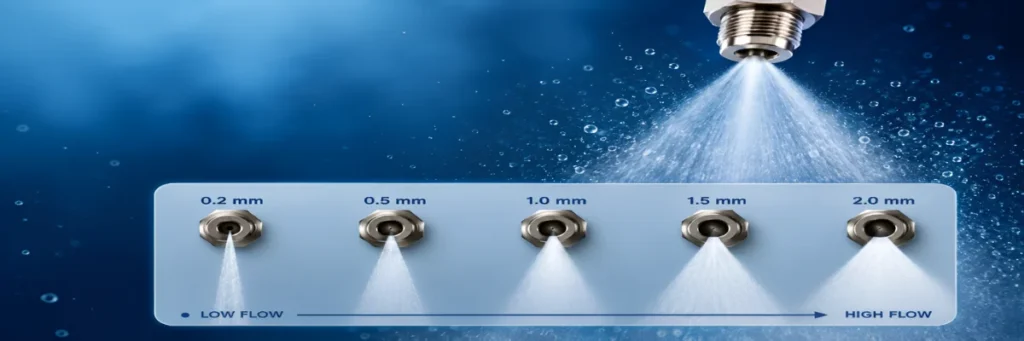
Nozzle orifice size is one of the most important factors in spray nozzle selection. It directly affects flow rate, spray pressure, droplet size, spray pattern, clogging risk, and overall spray performance.
Many industrial users select spray nozzles based only on thread size or material. But the orifice size is the actual opening through which the liquid passes. If the orifice size is too small, the nozzle may clog frequently or deliver less flow. If it is too large, it may waste water, reduce pressure, or cause over-wetting.
As a spray nozzle manufacturer, we help industries choose the correct nozzle orifice size for washing, cleaning, dust suppression, cooling, misting, humidification, chemical spraying, tank cleaning, and process applications.
Why Nozzle Orifice Size Is Important in Spray Nozzles
Nozzle orifice size is important because it decides how the nozzle performs in actual working conditions. Even if the spray pattern and material are correct, a wrong orifice size can reduce system efficiency.
Correct Orifice Size Helps To:
- Maintain proper flow rate
- Achieve required spray coverage
- Improve washing and cleaning performance
- Reduce water wastage
- Control dust more effectively
- Maintain correct droplet size
- Reduce nozzle clogging
- Avoid over-wetting
- Improve chemical spraying accuracy
- Increase spray system reliability
A nozzle with the wrong orifice size can lead to poor spray pattern, uneven distribution, low pressure, excessive water usage, or frequent blockage.
How Nozzle Orifice Size Affects Flow Rate
Flow rate is the amount of liquid discharged by the nozzle. The orifice size has a direct effect on flow rate.
At the same pressure:
- A small orifice nozzle gives lower flow.
- A large orifice nozzle gives higher flow.
For example, if two nozzles operate at the same pressure but have different orifice sizes, the nozzle with the larger orifice will discharge more water.
Simple Example
| Nozzle Type | Orifice Size | Flow Rate |
|---|---|---|
| Small Orifice Nozzle | Smaller opening | Lower flow |
| Large Orifice Nozzle | Larger opening | Higher flow |
This is why orifice size should be selected only after checking the required flow rate and available pressure.
How Orifice Size Affects Spray Pressure
Nozzle orifice size and pressure are closely connected. If the orifice size is too large for the pump capacity, the system pressure may drop. If the orifice size is too small, pressure may increase but flow may not be enough for the application.
Common Problems
| Condition | Result |
|---|---|
| Orifice too small | Low flow, frequent clogging, poor coverage |
| Orifice too large | Pressure drop, excess water, weak spray pattern |
| Correct orifice size | Proper pressure, flow, coverage, and performance |
The nozzle should match the pump capacity and pipeline design.
How Orifice Size Affects Droplet Size
Orifice size also affects droplet size. Droplet size is important for dust suppression, misting, cooling, humidification, chemical spraying, and washing applications.
Generally:
- Smaller orifice nozzles can produce finer droplets when pressure is suitable.
- Larger orifice nozzles usually produce larger droplets and higher flow.
Droplet Size Selection
| Droplet Type | Suitable Application |
|---|---|
| Fine droplets | Dry fog, misting, humidification, evaporative cooling |
| Medium droplets | Dust suppression, cooling, general spraying |
| Larger droplets | Washing, cleaning, material wetting, high-impact spray |
Fine droplets are useful for airborne dust capture and cooling, while larger droplets are useful for washing and wetting.
How Orifice Size Affects Nozzle Clogging
Clogging risk increases when the nozzle orifice is small. Fine mist nozzles, fog nozzles, and low-flow nozzles require cleaner water and better filtration.
If the water contains dust, sand, rust, scale, or suspended solids, small orifice nozzles can block quickly.
Small Orifice Nozzles Need:
- Clean water
- Proper filtration
- Regular filter cleaning
- Pipeline flushing
- Good maintenance
- Proper water treatment if required
For dirty water or recycled water, a larger passage nozzle or suitable filtration system should be considered.
Small Orifice vs Large Orifice Nozzle
| Point | Small Orifice Nozzle | Large Orifice Nozzle |
|---|---|---|
| Flow Rate | Lower | Higher |
| Droplet Size | Finer | Larger |
| Clogging Risk | Higher | Lower |
| Water Requirement | Lower | Higher |
| Best For | Misting, fogging, fine spraying | Washing, wetting, dust suppression |
| Filtration Need | Higher | Moderate |
| Spray Impact | Lower to medium | Medium to high |
| Maintenance | More frequent | Less frequent |
Both small and large orifice nozzles are useful. The right selection depends on the application.
When Should You Choose a Small Orifice Nozzle?
A small orifice nozzle is suitable when low flow and fine droplets are required.
Choose Small Orifice Nozzles For:
- Fine misting
- Fogging systems
- Humidification
- Evaporative cooling
- Dry fog dust suppression
- Low-flow chemical spraying
- Fine moisture control
- Applications where over-wetting must be avoided
Important Note
Small orifice nozzles should be used only with proper filtration and clean water. Otherwise, frequent clogging can occur.
When Should You Choose a Large Orifice Nozzle?
A large orifice nozzle is suitable when higher flow, larger droplets, or stronger wetting is required.
Choose Large Orifice Nozzles For:
- Industrial washing
- Surface cleaning
- Material wetting
- General dust suppression
- Cooling with higher water flow
- Fire protection support spraying
- Dirty water applications with suitable design
- Stockyard and conveyor area spraying
Large orifice nozzles are more tolerant of water impurities compared to fine mist nozzles, but filtration is still recommended.
Orifice Size and Spray Pattern
The orifice size should be selected along with the spray pattern. The same orifice size can behave differently in different nozzle designs.
Common Spray Patterns
| Spray Pattern | Orifice Selection Focus |
|---|---|
| Flat Fan Nozzle | Flow, impact, spray width |
| Full Cone Nozzle | Area coverage, liquid distribution |
| Hollow Cone Nozzle | Fine spray, gas-liquid contact |
| Mist/Fog Nozzle | Fine droplets, low flow |
| Solid Stream Nozzle | High impact, jet force |
| Tank Cleaning Nozzle | Cleaning radius, flow, pressure |
For example, a flat fan nozzle with a larger orifice may be selected for washing, while a mist nozzle with a smaller orifice may be selected for humidification.
Orifice Size and Liquid Quality
Liquid quality plays an important role in orifice size selection. If the liquid is clean, small orifice nozzles can be used safely. If the liquid contains particles, the nozzle may clog.
Check Liquid Quality Before Selection
- Is the water clean or dirty?
- Does it contain sand or dust?
- Is the water hard?
- Does it contain scale-forming minerals?
- Is recycled water being used?
- Does the liquid contain chemicals?
- Does it contain oil, sludge, or suspended solids?
- Is the liquid corrosive?
For poor water quality, select a nozzle with a suitable passage size and install proper filtration.
Orifice Size and Filtration Requirement
Filtration is very important when using small orifice nozzles. The filter mesh should be selected according to the nozzle opening and water quality.
Benefits of Proper Filtration
- Reduces nozzle clogging
- Maintains spray pattern
- Improves nozzle life
- Reduces maintenance downtime
- Protects pump and valves
- Improves system performance
Fine misting systems, dry fog systems, and chemical spraying systems usually need better filtration than general washing systems.
Application-Wise Orifice Size Selection
1. Orifice Size for Washing and Cleaning
Washing and cleaning applications usually need enough flow and impact to remove dust, dirt, oil, or residue from surfaces.
Selection Focus
- Medium to large orifice
- Good impact force
- Correct spray angle
- Proper pressure
- Suitable material
Common Nozzle Type
- Flat fan nozzle
- High-impact flat fan nozzle
- Solid stream nozzle
2. Orifice Size for Dust Suppression
Dust suppression nozzle selection depends on dust type, moisture limit, and installation area.
Selection Focus
- Fine or medium droplets
- Controlled water usage
- Correct spray coverage
- Low clogging risk
- Suitable pressure
Common Nozzle Type
- Dry fog nozzle
- Mist nozzle
- Full cone nozzle
- Hollow cone nozzle
For fine airborne dust, smaller orifice mist/fog nozzles may be required. For material wetting or open-area dust control, medium or larger orifice nozzles may be suitable.
3. Orifice Size for Misting and Humidification
Misting and humidification applications need fine droplets and controlled water flow.
Selection Focus
- Small orifice
- Fine droplet size
- Clean water
- Good filtration
- Proper pressure
Common Nozzle Type
- Mist nozzle
- Fog nozzle
- Fine atomizing nozzle
Small orifice nozzles are commonly used here, but they need good water quality.
4. Orifice Size for Cooling Applications
Cooling applications may require fine droplets for evaporative cooling or medium droplets for surface cooling.
Selection Focus
- Droplet size
- Coverage area
- Flow rate
- Evaporation requirement
- Air movement
Common Nozzle Type
- Full cone nozzle
- Hollow cone nozzle
- Mist nozzle
- Fog nozzle
5. Orifice Size for Chemical Spraying
Chemical spraying needs accurate flow control and correct material compatibility.
Selection Focus
- Required chemical dosing
- Flow accuracy
- Chemical compatibility
- Clogging risk
- Spray pattern
- Pressure
Common Nozzle Type
- Flat fan nozzle
- Full cone nozzle
- Hollow cone nozzle
- Atomizing nozzle
For chemical spraying, never select orifice size without checking chemical concentration and flow requirement.
How to Select the Right Nozzle Orifice Size
To select the correct orifice size, follow these steps:
1. Identify the Application
Understand whether the nozzle is used for washing, dust suppression, cooling, misting, chemical spraying, or tank cleaning.
2. Decide Required Flow Rate
Calculate how much liquid is required per nozzle and for the full system.
3. Check Available Pressure
Confirm the actual pressure available at the nozzle point, not only at the pump.
4. Select Spray Pattern
Choose flat fan, full cone, hollow cone, mist, fog, solid stream, or tank cleaning type based on the application.
5. Check Droplet Size Requirement
Fine droplets, medium droplets, or large droplets should be selected based on the process.
6. Check Liquid Quality
If water quality is poor, avoid very small orifice nozzles unless good filtration is installed.
7. Select Suitable Material
Choose brass, SS304, SS316, plastic, ceramic, or special alloy based on liquid and site condition.
8. Confirm Pump Capacity
Make sure the pump can deliver the required total flow at the required pressure.
FAQs
1. What is nozzle orifice size in industrial spray nozzles?
Nozzle orifice size is the internal opening through which liquid comes out of the nozzle. It controls the flow rate, pressure performance, droplet size, spray quality, and clogging risk.
2. Is nozzle orifice size the same as nozzle thread size?
No. Thread size is the connection size used to fix the nozzle to a pipe or holder. Orifice size is the internal opening that controls liquid flow and spray performance.
3. How do I select the correct nozzle orifice size?
Select the nozzle orifice size based on required flow rate, available pressure, spray pattern, spray angle, droplet size, liquid quality, pump capacity, and application type.
4. What happens if the nozzle orifice is too small?
If the orifice is too small, the nozzle may give low flow, poor coverage, frequent clogging, pressure imbalance, weak washing, or uneven spray performance.
5. What happens if the nozzle orifice is too large?
If the orifice is too large, water consumption may increase, system pressure may drop, spray impact may reduce, and the process may face over-wetting.
6. Does orifice size affect nozzle flow rate?
Yes. At the same pressure, a larger orifice gives higher flow, while a smaller orifice gives lower flow. Flow rate should always be checked with the operating pressure.
7. Does orifice size affect spray droplet size?
Yes. Smaller orifices generally help produce finer droplets, while larger orifices usually produce bigger droplets and higher flow. Pressure and nozzle design also affect droplet size.
8. Which orifice size is best for dust suppression?
For fine airborne dust, small or medium orifice mist or fog nozzles may be suitable. For material wetting, stockyards, and open dust areas, medium or larger orifice nozzles may be better.
9. Which orifice size is best for industrial washing?
Industrial washing usually needs medium or larger orifice nozzles because washing requires enough flow and impact to remove dirt, dust, oil, or process residue.
10. Which orifice size is suitable for misting and fogging?
Misting and fogging systems generally use small orifice nozzles to produce fine droplets. Clean water and proper filtration are important to prevent clogging.
11. Why do small orifice nozzles clog frequently?
Small orifice nozzles clog because the opening is very small. Dirt, sand, rust, scale, algae, or chemical deposits can easily block the flow path.