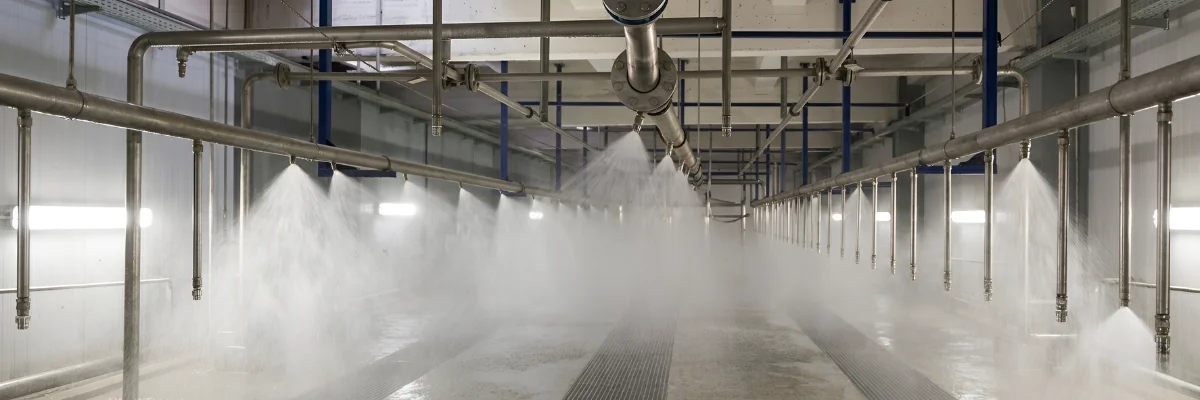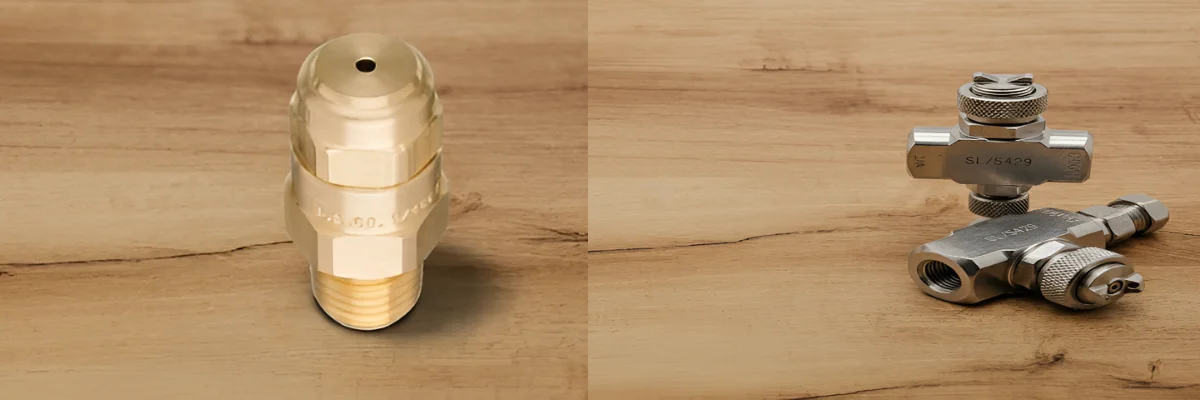
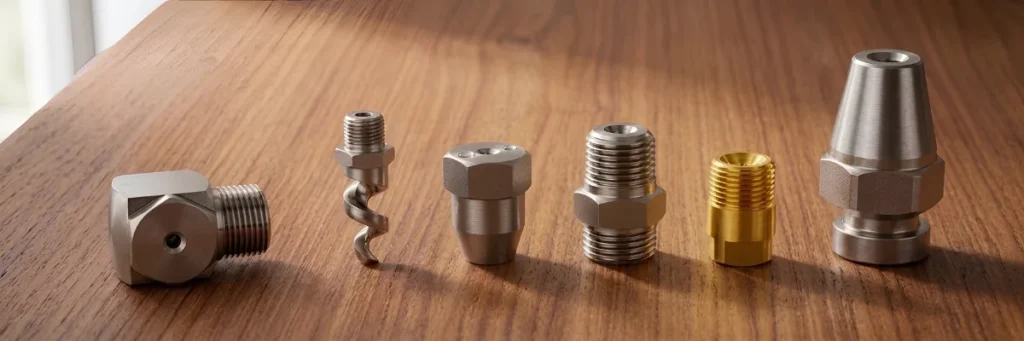
A spray nozzle may look like a small component, but it plays a major role in industrial performance. The right nozzle helps control spray coverage, flow rate, spray angle, droplet size, water usage, cleaning impact, cooling efficiency, and dust suppression performance.
The wrong spray nozzle can create many problems, such as uneven spraying, excess water consumption, poor washing results, nozzle clogging, over-wetting, chemical wastage, and frequent maintenance.
As a spray nozzle manufacturer, we supply different types of industrial spray nozzles for washing, cleaning, dust suppression, cooling, misting, humidification, chemical spraying, tank cleaning, and process applications. This guide will help you understand how to choose the right spray nozzle for your industrial application.
Why Choosing the Right Spray Nozzle Is Important
Every industrial spray system has a specific purpose. Some applications need strong impact for cleaning, while others need fine droplets for dust control or cooling. Some processes need uniform liquid distribution, while some require controlled chemical spraying.
A correctly selected spray nozzle can help you:
- Improve spray coverage
- Reduce water and chemical wastage
- Improve cleaning and washing performance
- Control dust more effectively
- Improve cooling and humidification
- Reduce nozzle clogging issues
- Improve process consistency
- Reduce maintenance downtime
- Increase nozzle life
- Improve overall system efficiency
So, nozzle selection should not be based only on thread size or price. It should be based on application, flow, pressure, pattern, material, and working condition.
Understand Your Spray Application First
The first step in choosing the right spray nozzle is to clearly understand the application. Different industrial applications need different spray patterns and nozzle designs.
Common Industrial Applications of Spray Nozzles
Spray nozzles are used in:
- Industrial washing and cleaning
- Dust suppression systems
- Cooling applications
- Misting and humidification
- Chemical spraying
- Surface treatment
- Coating and rinsing
- Tank cleaning
- Gas cooling
- Gas scrubbing
- Fire protection
- Lubrication
- Food processing washdown
- Conveyor belt cleaning
- Material wetting
For example, a flat fan nozzle is commonly used for surface washing, while a full cone nozzle is preferred for wider liquid distribution and dust suppression. A mist nozzle is useful when fine droplets are required.
Main Factors to Consider Before Selecting a Spray Nozzle
Choosing the right spray nozzle depends on several technical and practical factors. Below are the most important points to check.
1. Spray Pattern
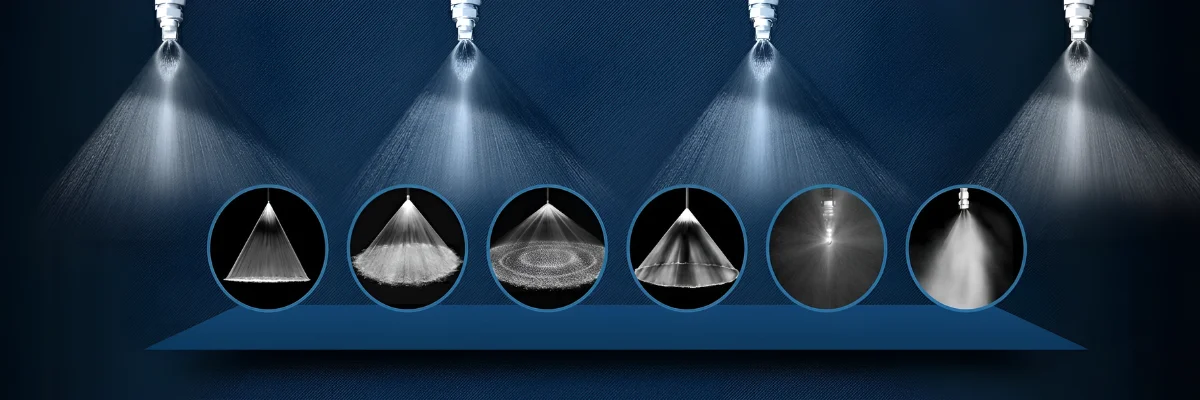
Spray pattern is one of the most important factors in nozzle selection. It decides how the liquid comes out of the nozzle and how it covers the target area.
Common Spray Patterns
| Spray Pattern | Best Used For |
|---|---|
| Flat Fan Spray | Surface washing, rinsing, conveyor cleaning, coating |
| Full Cone Spray | Dust suppression, cooling, liquid distribution, gas scrubbing |
| Hollow Cone Spray | Fine spray, cooling, humidification, gas treatment |
| Mist/Fog Spray | Dust control, misting, humidification, evaporative cooling |
| Solid Stream Spray | High-impact cleaning, jetting, long-distance spraying |
| Tank Cleaning Spray | Internal cleaning of tanks, vessels, drums, and containers |
How to Select the Right Spray Pattern
Choose a flat fan nozzle if you need a flat sheet of spray for washing or rinsing. Choose a full cone nozzle if you need round and even coverage. Choose a mist or fog nozzle if you need fine droplets for dust control, cooling, or humidification.
2. Flow Rate
Flow rate is the quantity of liquid discharged by the nozzle. It is usually measured in LPM, LPH, GPM, or m³/hr.
If the flow rate is too low, the spray may not cover the required area. If the flow rate is too high, it can waste water, increase operating cost, and cause over-wetting.
Flow Rate Depends On:
- Required coverage area
- Number of nozzles
- Pump capacity
- Operating pressure
- Application type
- Required wetting level
- Cooling or cleaning requirement
- Chemical dosing requirement
Simple Formula
Total Flow Required = Flow Rate per Nozzle × Number of Nozzles
For example, if one nozzle uses 2 LPM and the system has 20 nozzles:
Total Flow = 2 × 20 = 40 LPM
This helps in selecting the correct pump and pipeline size.
3. Operating Pressure
Operating pressure directly affects spray performance. It influences spray impact, flow rate, droplet size, and spray coverage.
A nozzle designed for low pressure may not perform well in a high-pressure system. Similarly, a high-pressure nozzle may not produce the correct spray pattern at low pressure.
Pressure-Based Selection
| Pressure Type | Common Application |
|---|---|
| Low Pressure | General spraying, wetting, low-pressure misting |
| Medium Pressure | Washing, dust suppression, cooling |
| High Pressure | Fine misting, atomization, high-impact cleaning |
| Very High Pressure | Heavy-duty cleaning and jetting |
For dust suppression and misting, pressure selection is very important because it affects droplet size. For washing applications, pressure affects impact force.
4. Spray Angle
Spray angle decides how wide the spray spreads after leaving the nozzle. Common spray angles include 15°, 25°, 40°, 65°, 80°, 90°, 110°, and 120°.
A narrow spray angle gives more concentrated impact. A wide spray angle covers more area but may reduce impact at the target surface.
Spray Angle Selection Tips
- Use narrow spray angles for strong impact and longer reach.
- Use wide spray angles for wider coverage.
- Consider distance between nozzle and target.
- Maintain proper overlap between nozzles.
- Avoid too much overlap, which can waste water.
- Avoid gaps between spray patterns.
For conveyor washing or surface cleaning, correct spray angle and nozzle spacing are very important to achieve uniform coverage.
5. Droplet Size
Droplet size is important in applications such as dust suppression, cooling, humidification, gas scrubbing, chemical spraying, and misting.
Different applications need different droplet sizes.
| Droplet Size | Suitable For |
|---|---|
| Fine Droplets | Dry fog, misting, humidification, evaporative cooling |
| Medium Droplets | General dust suppression, cooling, wetting |
| Large Droplets | Washing, cleaning, material wetting, high-impact spray |
Fine droplets are useful when the spray needs to mix with air or capture dust particles. Larger droplets are better when the purpose is washing, wetting, or impact cleaning.
Important Note
Fine droplets can drift in windy areas. Large droplets may cause excess wetting. So droplet size should be selected based on the site condition and application need.
6. Nozzle Material
Nozzle material affects nozzle life, corrosion resistance, chemical compatibility, temperature resistance, and cost.
Common Spray Nozzle Materials
| Material | Suitable Application |
|---|---|
| Brass | General water spraying and economical applications |
| SS304 | Industrial washing, cooling, dust suppression, general water use |
| SS316 | Chemical spraying, saltwater, coastal and corrosive environments |
| Plastic | Low-pressure chemical spraying and light-duty applications |
| Ceramic | Abrasive applications and high-wear conditions |
| Special Alloy | Highly corrosive or high-temperature applications |
How to Select Nozzle Material
Use SS304 spray nozzles for general industrial water spraying. Use SS316 spray nozzles where chemicals, saltwater, coastal air, or corrosive conditions are present. Use brass nozzles where cost is important and the application is not corrosive.
7. Liquid Type and Water Quality
The liquid used in the spray system can affect nozzle performance and nozzle life. Clean water, hard water, recycled water, chemicals, oils, and process liquids behave differently.
Check These Liquid Conditions
- Is the liquid clean or dirty?
- Does it contain suspended solids?
- Is the water hard or soft?
- Is it recycled water?
- Does it contain chemicals?
- Is the liquid corrosive?
- Is the liquid hot?
- Does it contain oil, sludge, or scale-forming minerals?
Poor water quality can cause nozzle clogging, scaling, corrosion, and uneven spray pattern. If the water contains particles, proper filtration is required.
8. Nozzle Orifice Size
The orifice is the opening through which liquid exits the nozzle. Orifice size affects flow rate, droplet size, clogging risk, and spray performance.
Small orifice nozzles are used for fine mist and low-flow applications, but they clog more easily. Larger orifice nozzles handle more flow and are less likely to clog, but they may produce larger droplets.
Selection Tip
Do not choose a very small orifice nozzle if the water quality is poor. For dusty or outdoor environments, proper filtration and larger passage nozzles may be required.
9. Clogging Risk and Filtration
Nozzle clogging is one of the most common problems in spray systems. Clogging can happen due to sand, rust, scale, dirt, algae, chemical deposits, and pipe contamination.
How to Reduce Nozzle Clogging
- Use proper filters and strainers
- Flush pipelines before installing nozzles
- Clean tanks and headers regularly
- Avoid very small orifice nozzles with dirty water
- Use treated water for misting and fogging systems
- Clean filters regularly
- Inspect spray patterns during operation
Fine mist nozzles and fog nozzles need better filtration because the orifice size is small.
10. Nozzle Placement and Spacing
Even a good nozzle will not perform properly if it is installed in the wrong position. Nozzle placement affects spray coverage, impact, dust capture, and overall performance.
Check These Installation Points
- Distance from nozzle to target
- Nozzle angle and direction
- Spray overlap
- Header pipe position
- Wind direction in outdoor applications
- Height from target surface
- Maintenance access
- Protection from physical damage
- Drain and flushing arrangement
For dust suppression, the nozzle should be installed close to the dust generation point. For washing, the nozzle should be positioned at the correct angle to achieve proper cleaning impact.
11. Pump Capacity and Pipeline Design
Spray nozzles must be matched with the pump and pipeline system. If the pump cannot supply the required pressure and flow, the nozzles will not perform correctly.
Check Before Finalizing Nozzles
- Flow rate per nozzle
- Number of nozzles
- Total flow requirement
- Required operating pressure
- Pipe size
- Pressure loss in pipeline
- Filter and valve pressure loss
- Pump capacity
- Future expansion requirement
If too many nozzles are connected to an undersized pump, pressure will drop and the spray pattern will become weak or uneven.
Application-Wise Spray Nozzle Selection Guide
Spray Nozzles for Washing and Cleaning
For washing and cleaning, spray impact and coverage are important. Flat fan nozzles are widely used because they create a controlled sheet of spray.
Suitable Nozzles
- Flat fan nozzles
- High-impact flat fan nozzles
- Solid stream nozzles
- Rotating cleaning nozzles
Common Applications
- Conveyor cleaning
- Parts washing
- Bottle washing
- Surface rinsing
- Vehicle washing
- Machine cleaning
Spray Nozzles for Dust Suppression
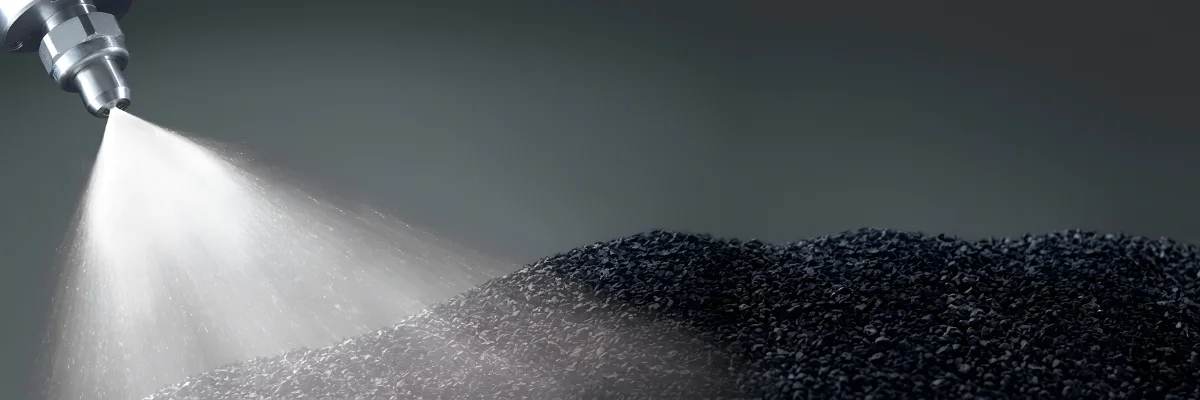
For dust suppression, droplet size, coverage, and water usage are important. The nozzle must control dust without unnecessary water wastage.
Suitable Nozzles
- Dry fog nozzles
- Mist nozzles
- Full cone nozzles
- Hollow cone nozzles
- Fine spray nozzles
Common Applications
- Crusher dust control
- Conveyor transfer points
- Coal handling plants
- Mining areas
- Cement plants
- Stockyards
- Loading and unloading points
Spray Nozzles for Cooling and Humidification
Cooling and humidification need correct droplet size and uniform distribution. Fine droplets are useful for evaporative cooling and humidity control.
Suitable Nozzles
- Mist nozzles
- Fog nozzles
- Hollow cone nozzles
- Fine atomizing nozzles
Common Applications
- HVAC cooling
- Greenhouse misting
- Textile humidification
- Industrial area cooling
- Gas cooling
- Process cooling
Spray Nozzles for Chemical Spraying
Chemical spraying requires accurate flow and proper material compatibility. Wrong nozzle material can cause corrosion and early failure.
Suitable Nozzles
- Flat fan nozzles
- Full cone nozzles
- Hollow cone nozzles
- Atomizing nozzles
Important Selection Points
- Chemical compatibility
- Flow accuracy
- Spray pattern
- Material of construction
- Temperature
- Pressure
- Corrosion resistance
Spray Nozzles for Tank Cleaning
Tank cleaning nozzles are used to clean the internal surfaces of tanks, vessels, drums, and containers. Selection depends on tank size, soil type, cleaning pressure, and required coverage.
Suitable Nozzles
- Static spray balls
- Rotating tank cleaning nozzles
- 360-degree tank cleaning nozzles
- High-impact tank washers
Common Applications
- Chemical tanks
- Food tanks
- Water tanks
- Process vessels
- Storage tanks
- CIP cleaning systems
Common Mistakes to Avoid While Choosing Spray Nozzles
Avoid these mistakes during nozzle selection:
- Selecting a nozzle only by thread size
- Ignoring spray pattern
- Choosing the wrong spray angle
- Not checking flow rate at actual pressure
- Using the wrong nozzle material for chemicals
- Ignoring water quality
- Not installing filters
- Using too many nozzles without checking pump capacity
- Installing nozzles too far from the target
- Using fine mist nozzles in dirty water
- Not planning maintenance access
- Selecting based only on price
FAQs
1. How do I choose the right spray nozzle?
To choose the right spray nozzle, check the application, spray pattern, flow rate, pressure, spray angle, droplet size, liquid type, material, orifice size, and installation distance.
2. Which spray nozzle is best for industrial washing?
Flat fan nozzles are commonly used for industrial washing because they provide controlled spray coverage and good surface impact.
3. Which spray nozzle is best for dust suppression?
Dry fog nozzles, mist nozzles, full cone nozzles, and hollow cone nozzles are used for dust suppression depending on dust type, area condition, droplet size, and moisture requirement.
4. What is the use of full cone spray nozzles?
Full cone spray nozzles are used for dust suppression, cooling, liquid distribution, gas scrubbing, chemical spraying, and general process applications.
5. What is the use of flat fan spray nozzles?
Flat fan spray nozzles are used for surface washing, conveyor cleaning, rinsing, coating, pretreatment, and controlled spray applications.
6. Why is spray angle important in nozzle selection?
Spray angle decides the coverage width of the spray. A narrow angle gives stronger impact, while a wide angle covers more area.
7. How does pressure affect spray nozzle performance?
Pressure affects flow rate, droplet size, spray impact, and spray coverage. Higher pressure can improve impact or atomization, but the nozzle must be suitable for that pressure.
8. What material is best for spray nozzles?
SS304 is suitable for general industrial applications, while SS316 is better for chemical, saltwater, coastal, and corrosive applications. Brass and plastic can also be used depending on the application.
9. Why do spray nozzles get clogged?
Spray nozzles get clogged due to dirt, sand, rust, scale, suspended solids, chemical deposits, poor filtration, and small orifice size.
10. Do you manufacture industrial spray nozzles?
Yes, we manufacture and supply industrial spray nozzles for washing, cleaning, dust suppression, cooling, misting, humidification, chemical spraying, tank cleaning, gas cooling, and process applications.