
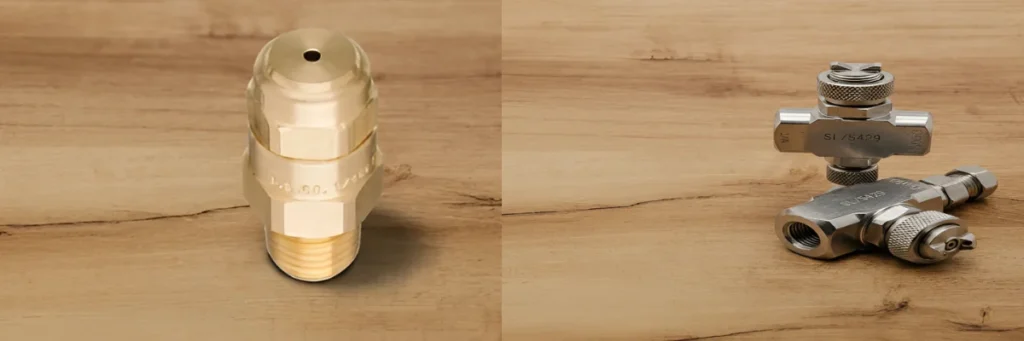
Choosing the right spray nozzle material is important for long-term performance, especially in industrial applications where nozzles are exposed to water, chemicals, pressure, temperature, dust, and continuous operation.
Two common materials used for spray nozzles are brass and stainless steel. Both materials are useful, but they are not suitable for every application. Brass nozzles are economical and suitable for general water spraying, while stainless steel nozzles are preferred for industrial, chemical, high-pressure, corrosive, and long-life applications.
As a spray nozzle manufacturer, we recommend selecting nozzle material based on the actual working condition, not only based on price. The right material can improve nozzle life, reduce replacement frequency, prevent corrosion, and maintain consistent spray performance
What Are Brass Spray Nozzles?
Brass spray nozzles are made from brass material and are commonly used in simple water spraying and general-purpose applications. Brass is easy to machine, cost-effective, and suitable for clean water systems where corrosion risk is low.
Brass nozzles are often selected when the application is not highly demanding and the system does not involve aggressive chemicals, saltwater, high temperature, or high pressure.
Benefits of Brass Spray Nozzles
- Lower initial cost
- Suitable for clean water applications
- Easy to replace
- Good for low and medium pressure systems
- Available in different spray patterns
- Practical for non-corrosive environments
What Are Stainless Steel Spray Nozzles?
Stainless steel spray nozzles are made from stainless steel grades such as SS304 and SS316. They provide better strength, corrosion resistance, wear resistance, and service life compared to brass nozzles.
Stainless steel nozzles are widely used in industrial environments where reliability, durability, and chemical resistance are important.
Benefits of Stainless Steel Spray Nozzles
- Better corrosion resistance
- Longer service life
- Stronger than brass
- Suitable for high-pressure applications
- Better for industrial environments
- Suitable for chemical and process applications
- Available in SS304 and SS316 grades
- Reduces frequent replacement in harsh conditions
Stainless steel nozzles are preferred when the application requires reliable performance, long life, and resistance to corrosion or wear.
Brass vs Stainless Steel Spray Nozzles: Main Difference
The main difference between brass and stainless steel spray nozzles is durability, corrosion resistance, and suitability for industrial use.
Brass is suitable for general, clean water, and low-cost applications. Stainless steel is suitable for industrial, chemical, high-pressure, corrosive, and continuous-duty applications.
| Comparison Point | Brass Spray Nozzle | Stainless Steel Spray Nozzle |
|---|---|---|
| Initial Cost | Lower | Higher |
| Corrosion Resistance | Moderate | Better |
| Strength | Moderate | High |
| Service Life | Shorter in harsh areas | Longer |
| Best Use | Clean water, simple spraying | Industrial and process applications |
| Chemical Resistance | Limited | Better, especially SS316 |
| Pressure Suitability | Low to medium | Medium to high |
| Wear Resistance | Moderate | Better |
| Maintenance | May need frequent replacement | Lower replacement frequency |
| Long-Term Value | Good for simple use | Better for demanding applications |
When Should You Choose Brass Spray Nozzles?
Brass spray nozzles are suitable when the spraying application is simple and the working environment is not harsh. They are mainly selected for economical systems where corrosion, chemical attack, and high pressure are not major concerns.
Choose Brass Nozzles If:
- The liquid is clean water
- The application is low or medium pressure
- Chemical exposure is not present
- The environment is not coastal or corrosive
- The nozzle is used for general spraying
- Budget is a major factor
- The nozzle is easy to replace
- The application is not continuous or critical
When Should You Choose Stainless Steel Spray Nozzles?
Stainless steel spray nozzles should be selected when the application needs better strength, corrosion resistance, pressure handling, and longer service life.
For industrial applications, stainless steel is usually the safer choice because nozzles are often exposed to moisture, chemicals, heat, dust, vibration, and continuous operation.
Choose Stainless Steel Nozzles If:
- The system is used continuously
- The application involves chemicals
- The liquid is salty, treated, or corrosive
- The site is near a coastal area
- Higher pressure is required
- The nozzle is used in dust suppression or industrial washing
- Maintenance access is difficult
- Longer nozzle life is required
- Failure of the nozzle can affect production or safety
Application-Wise Material Selection Guide
1. Industrial Washing and Cleaning
Industrial washing requires good spray impact, durability, and reliable performance. Brass may be suitable for light-duty washing with clean water. For regular industrial washing, stainless steel is recommended.
Recommended Material:
- Light-duty clean water washing: Brass
- Regular industrial washing: SS304
- Chemical or corrosive washing: SS316
2. Dust Suppression Systems
Dust suppression systems are usually installed in harsh environments such as crushers, conveyors, hoppers, stockyards, cement plants, mines, and coal handling plants.
These areas may have dust, vibration, outdoor exposure, and poor water quality. For this reason, stainless steel nozzles are generally preferred.
Recommended Material:
- General dust suppression: SS304
- Coastal, chemical, or corrosive dust areas: SS316
- Temporary low-cost clean water spraying: Brass may be considered
3. Chemical Spraying
Chemical spraying requires careful material selection. Brass may react with some chemicals and may not provide enough corrosion resistance.
For most chemical applications, stainless steel, especially SS316, is preferred. However, final selection should be based on chemical type, concentration, temperature, and compatibility.
Recommended Material:
- Mild chemical spraying: SS304 or SS316 depending on compatibility
- Corrosive chemical spraying: SS316 or suitable special material
- Low-pressure compatible chemical use: Plastic may also be considered
4. Misting and Cooling
For basic clean water misting or cooling, brass nozzles may be used. But for industrial misting, high-pressure misting, or continuous cooling systems, stainless steel nozzles provide better durability.
Recommended Material:
- Basic misting: Brass or SS304
- Industrial misting: SS304
- Coastal or corrosive cooling: SS316
- High-pressure misting: Stainless steel
5. Food and Beverage Applications
Food and beverage applications require hygiene, corrosion resistance, and regular cleaning compatibility. Stainless steel nozzles are generally preferred.
Brass is usually not the first choice for hygienic or critical food process areas.
Recommended Material:
- General washdown: SS304
- Cleaning chemical or salt exposure: SS316
- Hygienic process areas: Stainless steel based on process requirement
6. Coastal and Marine Applications
Coastal and marine environments contain salt and chloride exposure. Brass and even SS304 may corrode faster in such conditions.
SS316 stainless steel is usually recommended for longer life in coastal and marine areas.
Recommended Material:
- Coastal environment: SS316
- Saltwater spraying: SS316
- Marine application: SS316 or special alloy where required
How to Choose Between Brass and Stainless Steel Nozzles
Before selecting the nozzle material, check these important points:
1. Liquid Type
Check whether the liquid is clean water, dirty water, chemical, saltwater, detergent, oil, or process liquid.
2. Corrosion Risk
Check whether the nozzle will be exposed to chemicals, salt, humidity, wastewater, or coastal air.
3. Operating Pressure
Higher pressure applications generally need stronger and more durable materials.
4. Temperature
High-temperature applications may require stainless steel or special materials.
5. Water Quality
Hard water, dirty water, and recycled water can affect nozzle life and clogging.
6. Application Criticality
For continuous process applications, stainless steel is usually safer.
7. Maintenance Access
If the nozzle is difficult to remove or replace, choose a longer-life material.
8. Budget and Life Cycle Cost
Brass may reduce initial cost, but stainless steel can reduce replacement and maintenance cost in demanding applications.
FAQs
1. Which is better for industrial spray nozzles, brass or stainless steel?
Stainless steel is better for most industrial spray nozzle applications because it offers better strength, corrosion resistance, wear resistance, and longer service life. Brass is suitable for clean water and light-duty applications.
2. Can brass spray nozzles be used for industrial washing?
Yes, brass spray nozzles can be used for light-duty industrial washing with clean water. For regular industrial washing, high-pressure cleaning, or harsh site conditions, SS304 or SS316 nozzles are better.
3. Are brass spray nozzles suitable for dust suppression?
Brass nozzles may be used in simple dust suppression systems with clean water and low corrosion risk. For cement plants, coal handling plants, mines, crushers, and conveyors, stainless steel nozzles are generally preferred.
4. Which material is best for dust suppression nozzles?
SS304 is commonly used for general dust suppression. SS316 is better for coastal, chemical, corrosive, humid, or wastewater-based dust suppression systems.
5. Can brass spray nozzles be used with chemicals?
Brass should not be used with chemicals unless compatibility is confirmed. For many chemical spraying applications, SS316 or suitable plastic material is safer.
6. Which nozzle material is best for chemical spraying?
SS316 is commonly preferred for chemical spraying because it provides better corrosion resistance than brass and SS304. Final selection depends on chemical type, concentration, and temperature.
7. Is SS304 better than brass for spray nozzles?
Yes, SS304 is generally better than brass for industrial applications because it has better strength, corrosion resistance, and service life.
8. Is SS316 better than SS304?
SS316 provides better corrosion resistance than SS304, especially in chemical, saltwater, coastal, marine, and chloride-rich environments.
9. Which nozzle material is best for coastal areas?
SS316 stainless steel is recommended for coastal and marine areas because it offers better resistance to salt and chloride corrosion.
10. Are stainless steel nozzles worth the higher cost?
Yes, stainless steel nozzles are worth the higher cost in industrial, corrosive, high-pressure, continuous-duty, and difficult-to-maintain applications because they reduce replacement frequency and downtime.
11. Which material is suitable for high-pressure spray nozzles?
Stainless steel, especially SS304 or SS316, is generally suitable for high-pressure spray nozzles because it provides better strength and durability.
12. Do brass nozzles wear faster than stainless steel nozzles?
In harsh industrial environments, brass nozzles may wear or corrode faster than stainless steel nozzles. Stainless steel usually provides better long-term performance.
13. Which material is better for food and beverage spray nozzles?
Stainless steel nozzles are generally preferred for food and beverage applications because they are more durable, corrosion resistant, and suitable for washdown and cleaning processes.