
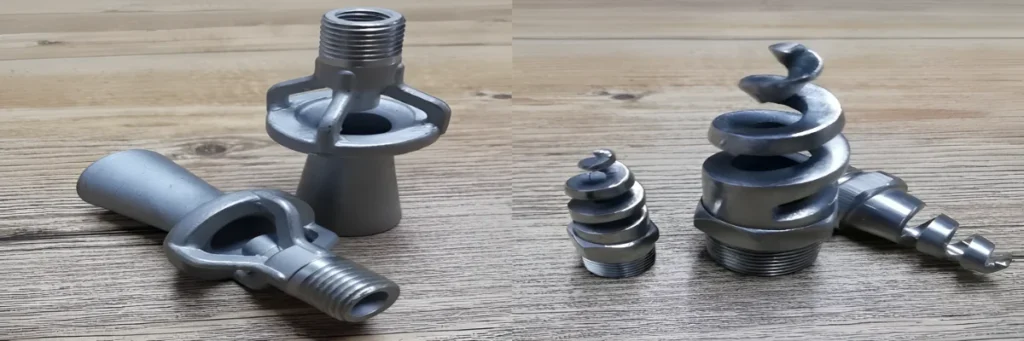
Choosing the right spray nozzle material is very important for long nozzle life, stable spray performance, and safe operation. Even if the nozzle type, spray angle, flow rate, and pressure are correct, the wrong material can cause corrosion, leakage, clogging, wear, or early nozzle failure.
Two commonly used stainless steel materials for industrial spray nozzles are SS304 and SS316. Both materials are strong, durable, and suitable for many industrial applications. However, they are not the same.
The main difference is corrosion resistance. SS304 spray nozzles are suitable for general water spraying, washing, cooling, and dust suppression. SS316 spray nozzles are better for chemical spraying, saltwater, coastal areas, marine use, wastewater, and corrosive environments.
As a spray nozzle manufacturer, we help customers choose the right nozzle material based on liquid type, chemical exposure, temperature, pressure, water quality, and site condition.
What Is an SS304 Spray Nozzle?
An SS304 spray nozzle is made from stainless steel grade 304. It is one of the most commonly used stainless steel materials for general industrial spray applications.
SS304 nozzles offer good strength, good corrosion resistance, and better durability than brass or plastic nozzles in many working conditions. They are commonly used where the liquid is clean water, treated water, or a mild chemical solution.
Common Applications of SS304 Spray Nozzles
SS304 spray nozzles are commonly used in:
- Water spraying systems
- General washing applications
- Cooling systems
- Dust suppression systems
- Conveyor washing
- Parts washing machines
- Food processing wash areas
- Surface cleaning
- Mild chemical spraying
- Humidification systems
Benefits of SS304 Spray Nozzles
- Good corrosion resistance for general use
- Suitable for clean water and treated water
- Cost-effective compared to SS316
- Stronger and more durable than brass or plastic in many applications
- Suitable for general industrial environments
- Available in flat fan, full cone, hollow cone, misting, fog, and other nozzle types
What Is an SS316 Spray Nozzle?
An SS316 spray nozzle is made from stainless steel grade 316. SS316 contains molybdenum, which improves resistance against corrosion, especially in chloride, saltwater, marine, coastal, and aggressive chemical environments.
SS316 nozzles are preferred where corrosion risk is higher and longer service life is required.
Common Applications of SS316 Spray Nozzles
SS316 spray nozzles are commonly used in:
- Chemical spraying systems
- Saltwater spraying
- Marine and coastal environments
- Wastewater treatment plants
- Acid and alkaline process areas
- Fertilizer plants
- Pharmaceutical applications
- Food and beverage cleaning
- High-humidity areas
- Scrubbing systems
- Corrosive process industries
Benefits of SS316 Spray Nozzles
- Higher corrosion resistance than SS304
- Better performance in saltwater and chloride environments
- Suitable for corrosive chemical applications
- Longer nozzle life in harsh conditions
- Better choice for coastal and marine industries
- Reliable for demanding industrial applications
Why SS316 Has Better Corrosion Resistance Than SS304
The main reason SS316 performs better in corrosive conditions is the presence of molybdenum. Molybdenum improves resistance against chloride corrosion, pitting, saltwater exposure, and many chemical environments.
This makes SS316 spray nozzles a better choice for:
- Coastal plants
- Marine applications
- Saltwater spraying
- Chemical process areas
- Wastewater treatment
- Fertilizer plants
- Scrubbing systems
- High-humidity industrial areas
However, SS316 is not suitable for every chemical. Some strong acids, solvents, high-temperature chemicals, or highly corrosive liquids may require special materials such as PVDF, PTFE, Hastelloy, or other alloys. Always check chemical compatibility before final selection.
SS304 vs SS316 Spray Nozzles: Main Difference
The main difference between SS304 and SS316 spray nozzles is corrosion resistance.
SS304 is suitable for general industrial applications where corrosion risk is low. SS316 is suitable for corrosive, chemical, saltwater, coastal, and demanding applications.
| Point | SS304 Spray Nozzle | SS316 Spray Nozzle |
|---|---|---|
| Corrosion Resistance | Good | Better |
| Chemical Resistance | Suitable for mild chemicals | Better for corrosive chemicals |
| Saltwater Resistance | Limited | Better |
| Coastal Area Suitability | Moderate | Better |
| Cost | More economical | Higher cost |
| Service Life in Corrosive Areas | Moderate | Longer |
| Best For | General water spraying and washing | Chemical, marine, saltwater, and corrosive use |
| Common Use | Washing, cooling, dust suppression | Scrubbing, chemical spraying, wastewater, coastal plants |
When Should You Choose SS304 Spray Nozzles?
You should choose SS304 spray nozzles when the application involves clean water, treated water, mild chemicals, general washing, cooling, or dust suppression where corrosion risk is low.
SS304 is a practical and economical choice for standard industrial applications.
Choose SS304 If:
- You are spraying clean water or treated water
- The chemical is mild and non-corrosive
- The plant environment is not coastal or marine
- The application is general cleaning or washing
- The nozzle is used in normal industrial conditions
- Budget is important
- You need a durable nozzle at a reasonable cost
Example
For a conveyor washing system using clean water or mild detergent solution, SS304 spray nozzles are usually suitable because the corrosion risk is low to moderate.
For dust suppression in cement plants, coal handling plants, mines, crushers, and conveyor transfer points, SS304 is commonly used when clean or treated water is available.
When Should You Choose SS316 Spray Nozzles?
You should choose SS316 spray nozzles when the application involves corrosive liquids, chemicals, saltwater, high humidity, coastal conditions, wastewater, or process fluids that can attack normal stainless steel.
SS316 is preferred when better corrosion resistance and longer nozzle life are required.
Choose SS316 If:
- You are spraying saltwater or brine
- The plant is located near a coastal area
- The liquid contains chlorides
- The application involves chemicals
- The nozzle is used in wastewater or effluent treatment
- The process area has high humidity or corrosive vapours
- You need longer nozzle life in harsh conditions
- The cost of nozzle failure is high
Example
For a chemical scrubbing system or saltwater spraying application, SS316 spray nozzles are better because they resist corrosion more effectively than SS304.
For a coastal power plant, SS316 nozzles are usually recommended because salty air and chloride exposure can reduce the life of SS304 nozzles.
Which Material Is Better for Dust Suppression?
For most dust suppression systems using clean or treated water, SS304 spray nozzles are suitable and cost-effective.
SS304 nozzles are commonly used in:
- Coal handling plants
- Cement plants
- Mines
- Crushers
- Conveyor transfer points
- Material handling systems
However, SS316 spray nozzles are recommended when:
- Water contains salts or chemicals
- The site is near the sea
- The system is used in corrosive plant areas
- Dust contains aggressive chemical particles
- Longer nozzle life is required
- Maintenance access is difficult
For fertilizer plants, chemical industries, coastal power plants, and aggressive dust environments, SS316 may be the better choice.
Which Material Is Better for Chemical Spraying?
For chemical spraying, SS316 is generally better than SS304 because it provides improved corrosion resistance.
However, final selection depends on:
- Chemical type
- Chemical concentration
- Operating temperature
- Working pressure
- Exposure time
- Nozzle design
- Cleaning cycle
Some strong acids, solvents, and highly aggressive liquids may require special materials beyond SS316. For chemical applications, always check chemical compatibility before finalizing the nozzle material.
Which Material Is Better for Food and Beverage Applications?
Both SS304 and SS316 spray nozzles can be used in food and beverage applications depending on the process.
SS304 may be suitable for general water washing and washdown applications. SS316 is preferred where cleaning chemicals, sanitizing agents, salt content, or higher corrosion risk is involved.
For hygienic and critical process areas, SS316 is often preferred because it provides better corrosion resistance.
Which Material Is Better for Marine or Coastal Areas?
For marine, coastal, and saltwater environments, SS316 spray nozzles are usually the better choice.
SS304 can corrode faster in chloride-rich or salty environments. SS316 offers better resistance and longer service life in these conditions.
If your plant is located near the sea or uses saline water, SS316 is recommended.
Important Factors Before Selecting SS304 or SS316 Spray Nozzles
Before selecting nozzle material, check the following factors.
1. Liquid Type
Check whether the liquid is clean water, treated water, detergent, chemical, acid, alkali, oil, saltwater, brine, or process fluid.
2. Chemical Concentration
Higher chemical concentration can increase corrosion risk and may require better material resistance.
3. Operating Temperature
High temperature can increase corrosion risk and affect material life.
4. Water Quality
Hard water, saline water, recycled water, or untreated water may affect nozzle performance and service life.
5. Plant Environment
Coastal, chemical, fertilizer, wastewater, and humid environments may require SS316.
6. Maintenance Frequency
If nozzles are difficult to access or replacement downtime is costly, choose a more durable material.
7. Nozzle Life Expectation
For critical applications, longer nozzle life may be more important than initial cost.
Common Mistakes in Nozzle Material Selection
Avoid these common mistakes while choosing between SS304 and SS316 spray nozzles:
- Selecting nozzle material only based on price
- Using SS304 in saltwater applications
- Ignoring chemical compatibility
- Not checking operating temperature
- Using brass nozzles in corrosive areas
- Using plastic nozzles where high temperature is present
- Not considering water quality
- Assuming all stainless steel grades are the same
- Ignoring maintenance and replacement cost
FAQs About SS304 vs SS316 Spray Nozzles
1. What is the difference between SS304 and SS316 spray nozzles?
SS304 spray nozzles are suitable for general water spraying and mild chemical use. SS316 spray nozzles provide better corrosion resistance and are suitable for chemicals, saltwater, coastal areas, and corrosive environments.
2. Which is better for spray nozzles, SS304 or SS316?
SS316 is better for corrosive and chemical applications. SS304 is better for general water spraying, washing, cooling, and dust suppression where corrosion risk is low.
3. Can SS304 spray nozzles be used for dust suppression?
Yes, SS304 spray nozzles can be used for most dust suppression systems using clean or treated water in coal handling, cement plants, mines, conveyors, crushers, and material handling systems.
4. When should I use SS316 spray nozzles?
Use SS316 spray nozzles when spraying chemicals, saltwater, brine, recycled water, wastewater, or when the system is installed in coastal, marine, humid, or corrosive industrial environments.
5. Are SS316 spray nozzles more expensive than SS304?
Yes, SS316 spray nozzles are generally more expensive than SS304 because they offer better corrosion resistance. However, they may reduce replacement costs in corrosive applications.
6. Is SS304 suitable for chemical spraying?
SS304 may be suitable for mild chemical spraying, but SS316 is preferred for stronger chemicals or corrosive liquids. Chemical compatibility should always be checked before selection.
7. Which stainless steel nozzle is better for saltwater?
SS316 spray nozzles are better for saltwater and chloride-rich environments because they provide improved corrosion resistance compared to SS304.
8. Can SS304 and SS316 nozzles be used in food industries?
Yes, both can be used depending on the process. SS304 is suitable for general water washing, while SS316 is preferred where cleaning chemicals, sanitizers, salt, or higher corrosion resistance are required.
9. Do SS304 spray nozzles rust?
SS304 has good corrosion resistance, but it can corrode in saltwater, chloride-rich, or harsh chemical environments. For such conditions, SS316 is recommended.
10. Is SS316 worth the higher cost?
SS316 is worth the higher cost when corrosion risk is high, nozzle replacement is difficult, or downtime is costly. For normal water applications, SS304 may be more economical.