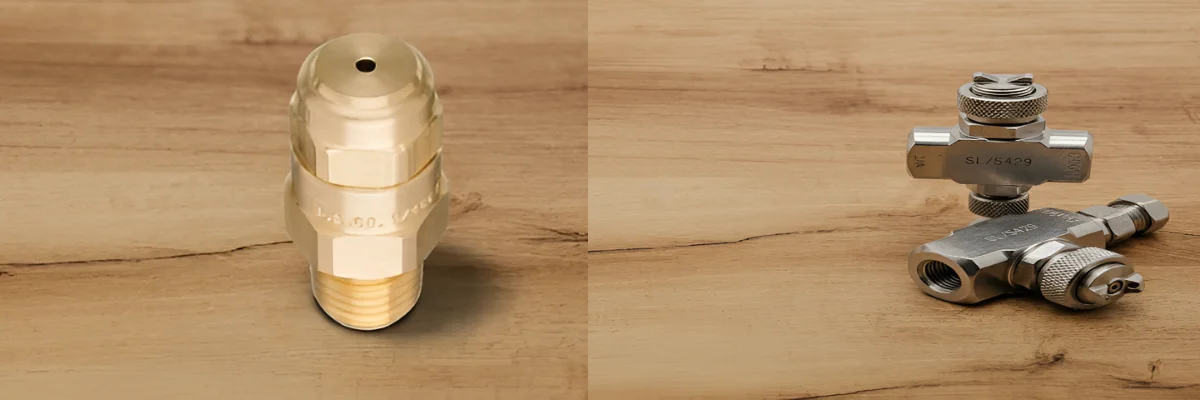
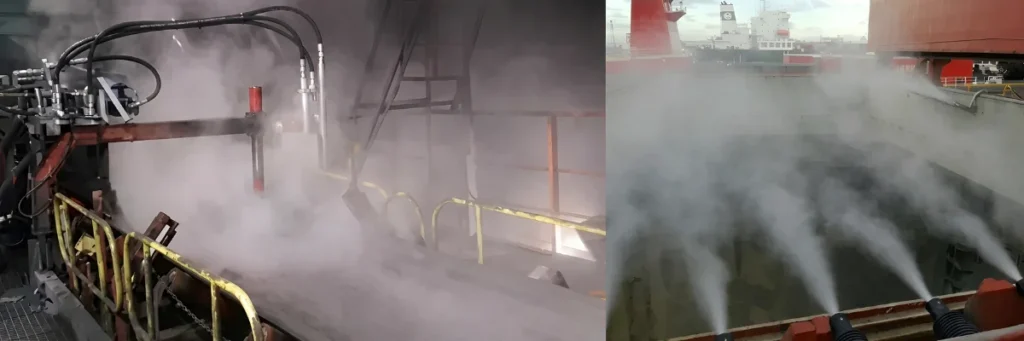
Dust suppression is important in industries where material handling, crushing, screening, conveying, loading, unloading, and storage activities generate airborne dust. If dust is not controlled properly, it can affect worker safety, equipment life, housekeeping, material loss, and environmental compliance.
Two common methods used for dust control are dry fog dust suppression and misting dust suppression. Both systems use water, but their working principle, droplet size, application method, water usage, and performance are different.
As a spray nozzle manufacturer, we help industries select the right dust suppression nozzle and system based on dust type, material condition, site layout, water availability, and process requirements.
What Is Dry Fog Dust Suppression?
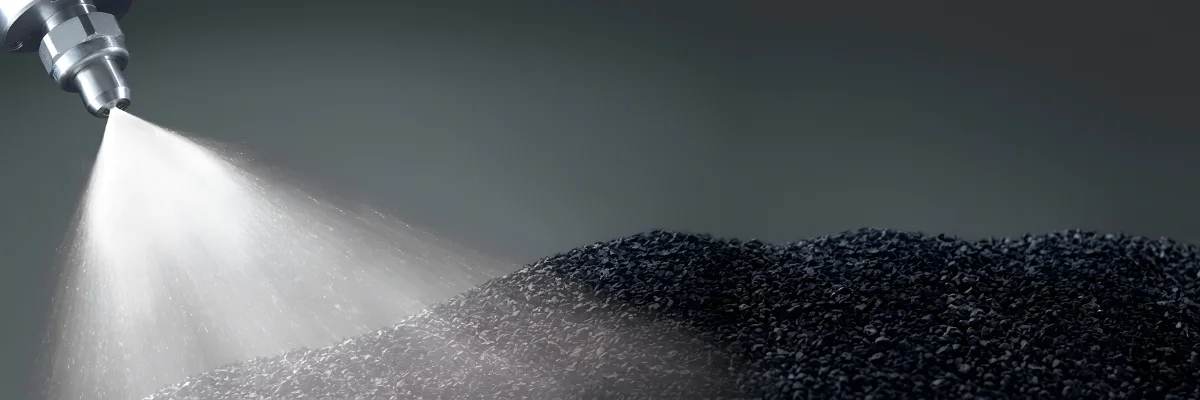
Dry fog dust suppression uses very fine water droplets to capture airborne dust particles. These droplets are small enough to mix with dust in the air without making the material heavily wet.
Dry fog systems are commonly used at enclosed or semi-enclosed dust generation points such as conveyor transfer points, crushers, screens, hoppers, chutes, and loading points.
The main purpose of dry fog is to control dust close to the source with minimum water addition.
Common Applications of Dry Fog Systems
Dry fog systems are commonly used in:
- Coal handling plants
- Cement plants
- Crusher houses
- Conveyor transfer points
- Screening areas
- Mining material handling
- Hoppers and chutes
- Wagon loading and unloading points
- Power plants
- Bulk material handling systems
What Is Misting Dust Suppression?
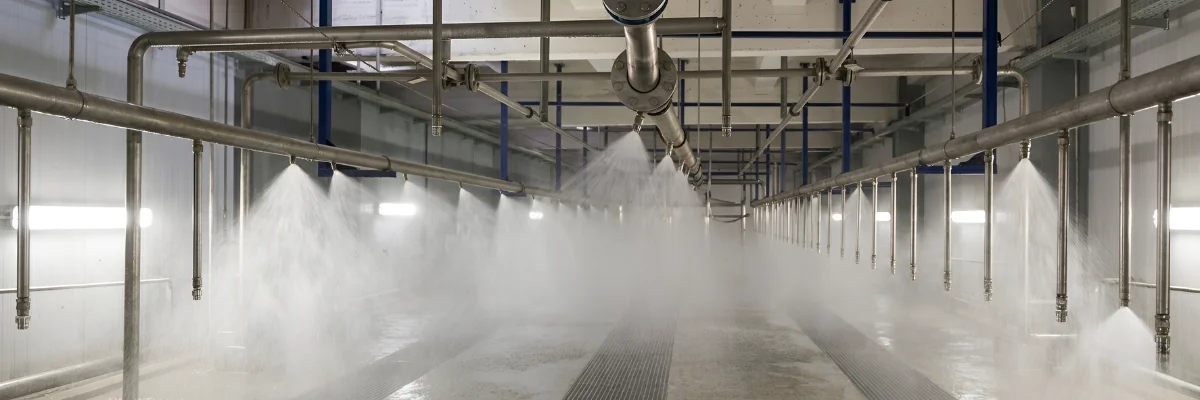
Misting dust suppression uses water spray in the form of mist droplets to wet dust particles, surfaces, and open areas. Misting systems can be used for dust control, cooling, odor control, and general area spraying.
Misting systems are commonly used in open or semi-open areas where dust spreads over a wider space. These systems may use low-pressure, medium-pressure, or high-pressure misting nozzles depending on the site requirement.
Common Applications of Misting Systems
Misting systems are commonly used in:
- Stockyards
- Open conveyor areas
- Construction sites
- Demolition areas
- Road dust control
- Loading yards
- Crusher surroundings
- Truck unloading areas
- Outdoor material storage areas
- Waste handling plants
Dry Fog vs Misting: Main Difference
The main difference between dry fog and misting is droplet size and dust control method.
Dry fog produces very fine droplets that combine with airborne dust particles and settle them without excessive wetting. Misting produces fine to medium droplets that help wet dust, surfaces, and open areas.
| Point | Dry Fog Dust Suppression | Misting Dust Suppression |
|---|---|---|
| Droplet Size | Very fine droplets | Fine to medium droplets |
| Main Purpose | Capture airborne dust near source | Wet dust and control spread |
| Wetting Level | Very low wetting | Moderate wetting |
| Best For | Enclosed transfer points, crushers, chutes | Open areas, yards, roads, stockpiles |
| Water Usage | Usually lower for point-source dust | Depends on area and flow rate |
| Air Requirement | Often uses compressed air in twin-fluid systems | Usually water-pressure based |
| Installation Area | Close to dust generation point | Around open or wide areas |
| Dust Type | Fine airborne dust | General dust and surface dust |
| System Design | Requires precise nozzle placement | Covers larger areas |
| Common Industries | Coal, cement, mining, power plants | Construction, stockyards, mining, waste handling |
How Dry Fog Works
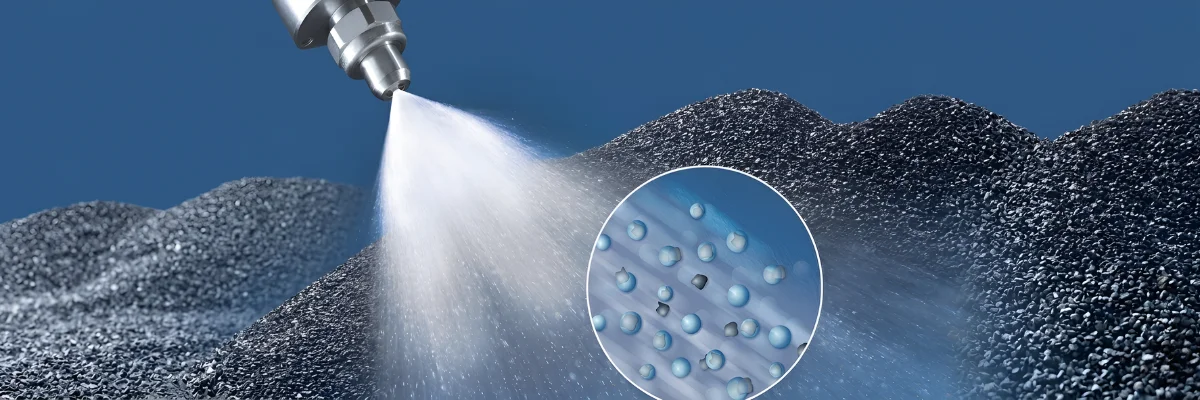
Dry fog systems generate fine water droplets through atomizing nozzles. These droplets come in contact with dust particles in the air. When droplets and dust particles collide, they become heavier and settle down.
The key advantage of dry fog is that it controls dust without adding too much moisture to the material.
Dry Fog Working Steps
- Dust is generated at the source.
- Fine fog droplets are sprayed near the dust cloud.
- Droplets collide with dust particles.
- Dust becomes heavier.
- Dust settles back onto the material or surface.
- Airborne dust is reduced.
Dry fog works best when the dust source is enclosed or partially covered, because fine droplets need contact time with airborne dust.
How Misting Works
Misting systems spray water mist over dusty areas or dust-generating points. The mist droplets wet dust particles and surfaces, reducing the chance of dust becoming airborne.
Misting is practical when the dust is spread across a larger area or when the site condition does not allow enclosed dry fog installation.
Misting Working Steps
- Water is pressurized through a pump or line pressure.
- Mist nozzles create fine droplets.
- Mist is sprayed over the target area.
- Dust particles and surfaces become slightly wet.
- Airborne dust is reduced.
- Dust spread is controlled over a larger area.
Quick Selection Guide
| Site Condition | Recommended System |
|---|---|
| Conveyor transfer point | Dry fog |
| Crusher discharge area | Dry fog |
| Screen or chute opening | Dry fog |
| Moisture-sensitive material | Dry fog |
| Open stockyard | Misting |
| Road dust control | Misting |
| Construction or demolition site | Misting |
| Truck unloading area | Misting |
| Large open dust area | Misting |
| Plant with multiple dust zones | Dry fog + misting |
When Should You Choose Dry Fog?
You should choose dry fog dust suppression when dust is generated at a specific point and you want to control it without making the material too wet.
Dry fog is suitable for process areas where excessive water can create problems such as material sticking, belt slippage, chute blockage, or product quality issues.
Choose Dry Fog If:
- Dust is generated at a conveyor transfer point
- Dust is fine and airborne
- Material should not become too wet
- Water usage must be reduced
- Dust source can be enclosed or partially covered
- You need targeted dust suppression
- The application is in coal, cement, mining, or power plant handling systems
Example
In a coal handling conveyor transfer point, dry fog can suppress airborne coal dust without soaking the coal. This helps reduce dust while avoiding excessive moisture, belt slippage, and chute blockage.
When Should You Choose Misting?
You should choose misting dust suppression when dust spreads across an open area or when the system needs to cover a wider zone.
Misting is suitable for general dust control where slight wetting is acceptable.
Choose Misting If:
- Dust is generated in open areas
- You need to cover a large area
- The application is stockyard, road, construction, or demolition
- Moderate wetting is acceptable
- You need simple installation
- You want dust control and cooling together
- The dust source cannot be fully enclosed
Example
In a stockyard or road dust control application, misting is usually more practical because the dust source is spread across a wide area and requires broader coverage.
Which System Uses Less Water?
In many point-source dust control applications, dry fog systems use less water because they use fine droplets targeted directly at the dust source. The aim is not to soak the material, but to capture airborne dust.
Misting systems may require more water when large areas need to be covered. However, water consumption depends on nozzle flow rate, pressure, operating time, number of nozzles, and automation control.
To reduce water usage in both systems, industries should use:
- Correct nozzle selection
- Proper nozzle spacing
- Timer-based operation
- Sensor-based automation
- Zone-wise control
- Correct pressure setting
- Regular nozzle maintenance
Why Droplet Size Matters in Dust Suppression
Droplet size is one of the most important factors in dust suppression.
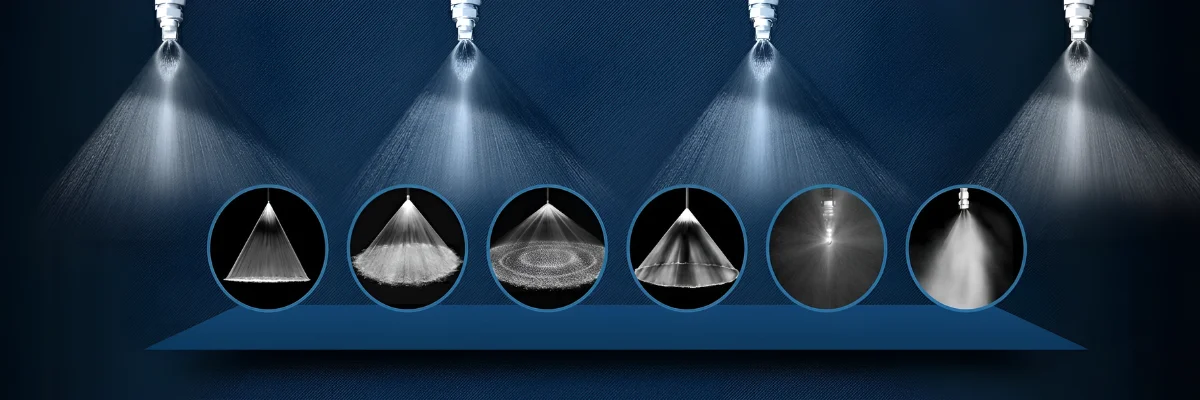
Very fine droplets are useful for capturing fine airborne dust because they can remain suspended and mix with dust particles. Larger droplets are better for wetting surfaces, roads, stockpiles, and heavier dust.
Dry fog is mainly used for airborne dust capture near the source. Misting is mainly used for area coverage, surface wetting, and dust spread control.
Which System Is Better for Coal Handling?
For coal handling plants, both dry fog and misting can be used depending on the location.
Dry Fog Is Suitable For:
- Conveyor transfer points
- Crusher discharge points
- Screen areas
- Chute openings
- Hopper discharge points
Misting Is Suitable For:
- Coal stockyards
- Open conveyors
- Truck unloading areas
- Road dust
- Boundary dust control
- Wagon loading areas
For best performance, many coal handling plants use dry fog at transfer points and misting in open areas.
Which System Is Better for Mining Dust Control?
In mining applications, dust comes from multiple sources. Dry fog is useful for crushers, transfer points, and enclosed dust generation points. Misting is useful for haul roads, open yards, unloading points, and large dust-prone zones.
The correct selection depends on:
- Dust particle size
- Material moisture sensitivity
- Wind condition
- Area size
- Water availability
- Equipment movement
- Site layout
- Dust source location
Which System Is Better for Cement Plants?
Cement plants often handle dry and fine materials, so excess water can create process problems. In such cases, dry fog is generally preferred at transfer points, conveyors, crushers, packing areas, and material handling points.
Misting can be used in outdoor areas, roads, raw material yards, and vehicle movement zones where moisture is acceptable.
Advantages of Dry Fog Dust Suppression
Dry fog systems are preferred where moisture control is important.
Key Advantages
- Controls fine airborne dust
- Uses less water in point-source applications
- Reduces material wetting
- Suitable for enclosed transfer points
- Helps reduce dust near the source
- Can be automated with conveyors and equipment
- Useful for coal, cement, mining, and power plants
Limitations of Dry Fog Dust Suppression
Dry fog is not suitable for every dust problem.
Limitations
- Requires correct nozzle placement
- Works best in enclosed or semi-enclosed areas
- May need compressed air in twin-fluid systems
- Less effective in very windy open areas
- Requires good water filtration
- Needs proper maintenance to prevent nozzle blockage
Advantages of Misting Dust Suppression
Misting systems are useful for wider dust control areas.
Key Advantages
- Covers larger areas
- Suitable for open dust control
- Can support cooling along with dust control
- Simple to install in many locations
- Useful for stockyards and construction sites
- Can be operated zone-wise
- Available in low, medium, and high-pressure options
Limitations of Misting Dust Suppression
Misting systems also have some limitations.
Limitations
- Can increase surface wetting
- May consume more water for large areas
- Fine mist can drift in strong wind
- Not ideal where material moisture must be strictly controlled
- Requires proper pressure and nozzle selection
- Poor design can cause water wastage
Important Factors Before Selecting Dry Fog or Misting
Before selecting a dust suppression method, check these important points.
1. Dust Source
If dust is generated at one specific point, dry fog may be better. If dust spreads across a large open area, misting may be more practical.
2. Material Moisture Sensitivity
If the material cannot tolerate excess water, dry fog is usually preferred.
3. Area Condition
Dry fog works better in enclosed or covered locations. Misting works better in open and wide areas.
4. Droplet Size
Fine droplets help capture airborne dust. Larger droplets help wet surfaces and heavier dust.
5. Wind Condition
Open areas with high wind need careful misting design, nozzle position, and spray direction.
6. Water Quality
Both systems require clean water. Fine nozzles especially need proper filtration to avoid clogging.
7. Automation Requirement
Systems connected with conveyor operation, sensors, timers, or PLC controls can reduce water waste and improve performance.
Role of Nozzles in Dust Suppression
Nozzles play an important role in both dry fog and misting systems. The wrong nozzle can lead to poor dust control, water wastage, clogging, or over-wetting.
As a dust suppression nozzle manufacturer, we recommend selecting nozzles based on:
- Required droplet size
- Flow rate
- Operating pressure
- Spray angle
- Coverage area
- Material of construction
- Water quality
- Installation distance
- Dust generation level
For dry fog systems, fine atomizing nozzles or twin-fluid nozzles are usually required. For misting systems, mist nozzles, fog nozzles, or full cone nozzles may be selected depending on the area and dust type.
Dry Fog or Misting: Which One Should You Choose?
There is no single answer for every site. The right system depends on the dust source, site condition, and material requirement.
Choose dry fog for point-source dust control where fine dust must be controlled without heavy wetting.
Choose misting for open-area dust control where wider coverage and moderate wetting are acceptable.
In many industrial plants, the best solution is a combination of both systems. Dry fog can be used at transfer points and crushers, while misting can be used in open yards, roads, and stockpile areas.
FAQs: Dry Fog vs Misting for Dust Suppression
1. What is the difference between dry fog and misting?
Dry fog uses very fine droplets to capture airborne dust near the source with minimum wetting. Misting uses fine spray droplets to wet dust, surfaces, and open areas to control dust spread.
2. Which is better for dust suppression: dry fog or misting?
Dry fog is better for enclosed point-source dust control, such as conveyor transfer points, crushers, and chutes. Misting is better for open areas such as stockyards, roads, construction sites, and unloading zones.
3. Does dry fog make material wet?
Dry fog adds very low moisture compared to normal water spraying or misting. It is designed to control airborne dust without making the material heavily wet.
4. Where is dry fog dust suppression used?
Dry fog dust suppression is commonly used at conveyor transfer points, crusher discharge areas, screens, hoppers, chutes, coal handling plants, cement plants, mining plants, and power plants.
5. Where is misting dust suppression used?
Misting dust suppression is commonly used in stockyards, open conveyor areas, roads, construction sites, demolition sites, truck unloading areas, outdoor storage yards, and waste handling plants.
6. Which system uses less water: dry fog or misting?
Dry fog usually uses less water for point-source dust control because it targets dust directly at the source. Misting may require more water when covering large open areas.
7. Is dry fog suitable for coal handling plants?
Yes, dry fog is suitable for coal handling plants, especially at conveyor transfer points, crusher discharge points, chutes, screens, and hopper discharge areas where dust is generated at a fixed point.
8. Is misting suitable for open stockyards?
Yes, misting is suitable for open stockyards because it can cover wider areas and help control dust from material piles, vehicle movement, wind, and loading or unloading activities.
9. What type of nozzle is used in dry fog systems?
Dry fog systems usually use fine atomizing nozzles or twin-fluid nozzles. These nozzles produce very fine droplets for capturing airborne dust particles.
10. What type of nozzle is used in misting systems?
Misting systems use mist nozzles, fog nozzles, or fine spray nozzles. The nozzle type depends on pressure, coverage area, dust type, water flow, and installation location.
11. Can dry fog and misting be used together?
Yes, dry fog and misting can be used together in the same plant. Dry fog can be used at transfer points, crushers, and chutes, while misting can be used in open yards, roads, and stockpile areas.
12. Which system is better where material should not get wet?
Dry fog is usually better where material moisture must be controlled. It uses very fine droplets and reduces dust without adding excessive water to the material.
13. Does misting work in windy areas?
Misting can work in open areas, but strong wind can affect spray direction and reduce performance. In windy areas, nozzle placement, spray angle, pressure, and wind direction should be considered carefully.
14. What is the main benefit of dry fog dust suppression?
The main benefit of dry fog dust suppression is that it controls fine airborne dust near the source while using less water and reducing material wetting.
15. What is the main benefit of misting dust suppression?
The main benefit of misting dust suppression is that it can cover large open areas and control dust spread from roads, stockyards, construction sites, and outdoor material handling zones.