
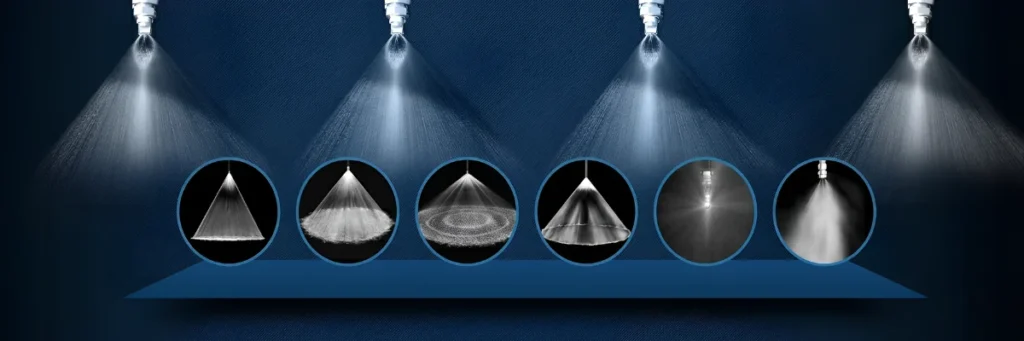
Selecting the right spray nozzle is important for getting proper performance from any industrial spray system. A nozzle should not be selected only by thread size, material, or price.
The three most important selection factors are flow rate, operating pressure, and spray pattern. These factors decide how much liquid is sprayed, how the liquid spreads, how much impact is created, and whether the spray reaches the target area properly.
As a spray nozzle manufacturer, we understand that every industry has different requirements. A nozzle used for conveyor washing may not be suitable for dust suppression. A nozzle used for cooling may not be suitable for chemical spraying.
This guide explains how to select spray nozzles based on flow, pressure, and spray pattern for applications such as washing, cleaning, dust suppression, cooling, misting, humidification, chemical spraying, gas scrubbing, and process spraying.
Comparison Table: Flow, Pressure, and Spray Pattern
| Selection Factor | What It Means | Why It Is Important | If Selected Wrong |
|---|---|---|---|
| Flow Rate | Quantity of liquid discharged by the nozzle in a specific time | Decides water or chemical quantity reaching the target area | Low flow causes poor coverage; high flow causes wastage |
| Operating Pressure | Pressure available at the nozzle inlet during working condition | Affects spray angle, droplet size, impact, and atomization | Low pressure causes weak spray; high pressure causes drift and wear |
| Spray Pattern | Shape of spray produced by the nozzle | Decides how liquid covers the target area | Wrong pattern causes uneven spraying and poor performance |
| Spray Angle | Width of spray coverage | Helps cover the required area with proper overlap | Wrong angle creates gaps or excessive overlap |
| Droplet Size | Size of liquid droplets produced by the nozzle | Important for dust control, cooling, washing, and misting | Wrong droplet size causes drift, over-wetting, or poor dust capture |
Spray Pattern Comparison Table
| Spray Pattern | Best Suitable For | Common Nozzle Type |
|---|---|---|
| Flat Fan Spray | Washing, rinsing, conveyor cleaning, surface treatment | Flat fan nozzle |
| Full Cone Spray | Dust suppression, cooling, liquid distribution, gas scrubbing | Full cone nozzle |
| Hollow Cone Spray | Gas cooling, humidification, fine chemical spraying | Hollow cone nozzle |
| Mist / Fog Spray | Fine dust control, misting, cooling, humidification | Mist nozzle, fog nozzle |
| Solid Stream Spray | High-impact cleaning and long-distance jetting | Solid stream nozzle |
| Tank Cleaning Spray | Internal cleaning of tanks and vessels | Static or rotating tank cleaning nozzle |
Benefits of Correct Spray Nozzle Selection
Choosing the correct spray nozzle based on flow, pressure, and spray pattern provides better system performance and reduces operating problems.
Key benefits include:
- Better spray coverage: The correct spray pattern helps liquid reach the target area evenly.
- Reduced water wastage: Proper flow rate prevents unnecessary water consumption.
- Lower chemical wastage: Accurate flow and pattern help control chemical usage.
- Improved cleaning performance: Correct pressure and spray angle provide better impact.
- Better dust suppression: Suitable droplet size and spray pattern help control airborne and surface dust.
- Improved cooling efficiency: Correct flow and droplet size help remove heat effectively.
- Reduced over-wetting: Proper nozzle selection prevents excess liquid on material.
- Lower clogging issues: Correct orifice size and filtration reduce blockage problems.
- Better pump performance: Matching flow and pressure helps avoid pump overload.
- Longer nozzle life: Correct pressure and material selection reduce wear and corrosion.
- Lower maintenance cost: A properly selected nozzle reduces downtime and frequent replacement.
Selection Guide: How to Select Spray Nozzles
1. Identify the Application
First, define the exact purpose of spraying. Different applications need different spray results.
Common applications include:
- Washing
- Cleaning
- Rinsing
- Dust suppression
- Cooling
- Misting
- Humidification
- Chemical spraying
- Gas cooling
- Gas scrubbing
- Tank cleaning
- Material wetting
- Surface treatment
For example, conveyor washing needs good impact and surface coverage. Dust suppression needs the right droplet size and spray location. Gas scrubbing needs proper liquid distribution and gas-liquid contact.
2. Choose the Correct Spray Pattern
The spray pattern should match the target area and application.
| Application | Recommended Spray Pattern |
|---|---|
| Surface washing | Flat fan |
| Conveyor cleaning | Flat fan |
| Parts washing | Flat fan or solid stream |
| Dust suppression | Full cone, mist, fog, hollow cone |
| Cooling | Full cone, hollow cone, mist |
| Humidification | Mist or fog |
| Chemical spraying | Flat fan, full cone, hollow cone |
| Gas scrubbing | Full cone, hollow cone, spiral |
| High-impact cleaning | Solid stream or high-impact flat fan |
| Tank cleaning | Static or rotating tank cleaning nozzle |
Selecting the wrong spray pattern can cause uneven coverage, poor cleaning, weak dust control, or chemical wastage.
3. Calculate the Required Flow Rate
Flow rate is the amount of liquid discharged by the nozzle in a specific time. It is commonly measured in LPM, LPH, GPM, or m³/hr.
Use this simple formula:
Total Flow Required = Flow per Nozzle × Number of Nozzles
Example:
If one nozzle requires 5 LPM and the system has 12 nozzles:
Total Flow Required = 5 × 12 = 60 LPM
The pump must be able to deliver this total flow at the required operating pressure.
If Flow Rate Is Too Low
- Poor spray coverage
- Weak washing performance
- Incomplete dust suppression
- Poor cooling effect
- Uneven chemical distribution
If Flow Rate Is Too High
- Water wastage
- Chemical wastage
- Over-wetting of material
- Higher pump load
- Increased operating cost
4. Check Actual Operating Pressure
Operating pressure is the pressure available at the nozzle inlet during working condition. It is usually measured in bar, kg/cm², or PSI.
Do not select the nozzle only based on pump pressure. The actual pressure at the nozzle point may be lower due to pressure loss.
Pressure loss can happen due to:
- Long pipeline length
- Small pipe diameter
- Dirty filters
- Valves
- Elbows and bends
- Hose length
- Elevation difference
- Multiple nozzle branches
A nozzle will perform correctly only when it receives the required pressure at the nozzle point.
5. Match Flow Rate with Pressure
Flow rate and pressure should be selected together. A nozzle gives a specific flow only at a specific pressure.
For example, if your requirement is 4 LPM at 3 bar, choose a nozzle that is rated to deliver 4 LPM at 3 bar.
Do not choose a nozzle rated at 4 LPM at 6 bar if your system provides only 3 bar. It may not give the required spray performance.
Always check the nozzle flow chart before final selection.
6. Select the Spray Angle
Spray angle decides how wide the spray spreads. It affects coverage width, overlap, and impact.
| Spray Angle Type | Best For |
|---|---|
| Narrow angle | Strong impact and focused spray |
| Medium angle | Balanced coverage and impact |
| Wide angle | Larger coverage with lower impact |
For conveyor washing, spray angle should match belt width and nozzle height.
For dust suppression, spray angle should cover the dust source without excessive water loss.
7. Check Droplet Size Requirement
Droplet size is important for dust suppression, cooling, humidification, chemical spraying, and washing.
| Application | Preferred Droplet Size |
|---|---|
| Washing | Medium to large droplets |
| Surface cleaning | Medium droplets with impact |
| Fine dust suppression | Fine droplets |
| Material wetting | Medium to large droplets |
| Cooling | Fine to medium droplets |
| Humidification | Fine droplets |
| Chemical spraying | Depends on dosing and drift control |
| Gas scrubbing | Fine to medium droplets |
Fine droplets are useful for airborne dust capture and evaporative cooling. Larger droplets are better for washing, wetting, and reducing spray drift.
8. Select the Right Nozzle Material
Nozzle material should be selected based on liquid type, pressure, temperature, and environment.
| Material | Suitable For |
|---|---|
| Brass | Clean water and low-cost spraying |
| SS304 | General industrial spraying |
| SS316 | Chemical, saltwater, coastal, and corrosive applications |
| Plastic | Low-pressure compatible chemical spraying |
| Ceramic | Abrasive or high-wear applications |
| Special Alloy | Highly corrosive or high-temperature applications |
For most industrial applications, SS304 and SS316 spray nozzles are commonly preferred because they offer better durability and corrosion resistance.
9. Check Water Quality and Filtration
Water quality directly affects nozzle performance. Dirty water can clog the nozzle and change the spray pattern.
Common causes of nozzle clogging include:
- Sand
- Dust
- Rust
- Scale
- Algae
- Sludge
- Chemical deposits
- Pipe contamination
Filtration is especially important for:
- Mist nozzles
- Fog nozzles
- Small-orifice nozzles
- Chemical spraying systems
- Dust suppression systems
- Recycled water systems
- High-pressure misting systems
Use suitable filters and clean them regularly to maintain spray performance.
10. Confirm Pump and Pipeline Capacity
Before finalizing the nozzle, confirm whether the pump and pipeline can support the selected nozzles.
Check these details:
- Total flow required
- Required pressure at nozzle point
- Pipe size
- Pump capacity
- Filter pressure loss
- Valve pressure loss
- Number of nozzles
- Future expansion requirement
If the pump is undersized, the spray pattern will be weak even if the nozzle is correctly selected.
Application-Wise Selection Guide
| Application | Spray Pattern | Pressure | Flow Rate | Droplet Size | Suggested Material |
|---|---|---|---|---|---|
| Washing and Cleaning | Flat fan or solid stream | Medium to high | Based on surface width | Medium to large | SS304 or SS316 |
| Dust Suppression | Full cone, mist, fog, hollow cone | Low to high | Controlled flow | Fine to medium | SS304 or SS316 |
| Cooling | Full cone, hollow cone, mist | Medium to high | Based on cooling load | Fine to medium | SS304 or SS316 |
| Chemical Spraying | Flat fan, full cone, hollow cone | Low to medium | Based on dosing | Based on process | SS316 or compatible material |
| Misting and Humidification | Mist or fog | Medium to high | Low and controlled | Fine | SS304 or SS316 |
| Gas Scrubbing and Gas Cooling | Full cone, hollow cone, spiral | Based on process | Based on gas volume | Fine to medium | SS316 or alloy |
Spray Nozzle Selection FAQs
1. How do I select a spray nozzle for industrial use?
Select a spray nozzle based on application, required flow rate, available pressure, spray pattern, spray angle, droplet size, liquid type, nozzle material, water quality, and installation distance.
2. Why are flow rate and pressure important in nozzle selection?
Flow rate decides how much liquid is sprayed. Pressure affects spray impact, droplet size, spray angle, and spray pattern. Both must match the application requirement.
3. How do I calculate total flow for a spray nozzle system?
Use this formula: Total Flow = Flow per Nozzle × Number of Nozzles. The pump must deliver this total flow at the required pressure.
4. What happens if nozzle pressure is too low?
If pressure is too low, the spray pattern may not open properly, droplet size may become larger, cleaning impact may reduce, and coverage may become uneven.
5. What happens if nozzle pressure is too high?
If pressure is too high, it can cause overspray, mist drift, leakage, faster nozzle wear, high pump load, pipe vibration, and safety issues.
6. Which spray pattern is best for washing?
Flat fan spray nozzles are commonly used for washing because they provide controlled surface coverage and good spray impact.
7. Which spray pattern is best for dust suppression?
Full cone, mist, fog, hollow cone, and air atomizing nozzles are used for dust suppression depending on dust type, droplet size, moisture limit, and site condition.
8. Which nozzle is best for chemical spraying?
Flat fan, full cone, hollow cone, or atomizing nozzles can be used for chemical spraying. Material compatibility, flow accuracy, and pressure control are important.
9. Does spray pattern affect water consumption?
Yes. A wrong spray pattern can spray outside the target area and waste water. The correct pattern improves coverage and reduces unnecessary water use.
10. Can one nozzle type be used for all applications?
No. Washing, dust suppression, cooling, misting, chemical spraying, and tank cleaning require different spray patterns, pressures, and flow rates.
11. How does pressure affect droplet size?
Higher pressure generally produces smaller droplets, while lower pressure usually produces larger droplets. Nozzle design and orifice size also affect droplet size.
12. How do I choose nozzle flow rate?
Choose nozzle flow rate based on area coverage, wetting requirement, cleaning load, dust level, cooling demand, chemical dosing, and number of nozzles.
13. How do I know if my pump is suitable for selected nozzles?
Check total flow requirement, required pressure at nozzle point, pipe loss, filter loss, valve loss, and pump performance curve.
14. What material should I choose for industrial spray nozzles?
SS304 is suitable for general industrial use. SS316 is better for chemicals, saltwater, coastal, wastewater, and corrosive applications. Brass is suitable for simple clean water spraying.