
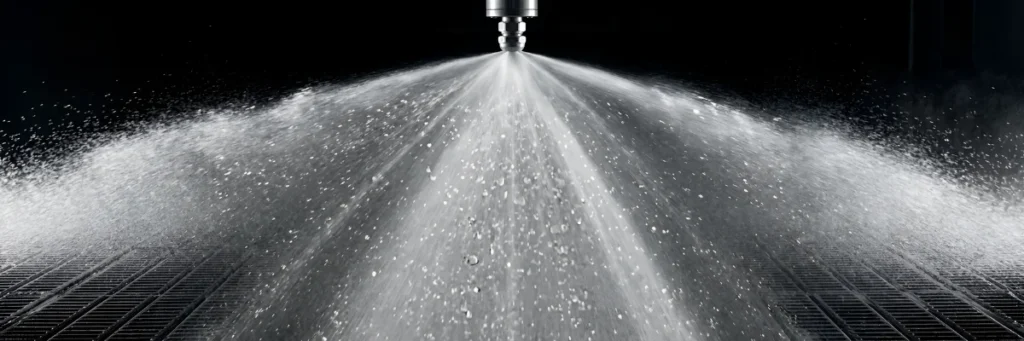
Spray angle is one of the most important factors to check before selecting a spray nozzle. It decides how wide the liquid spreads after coming out of the nozzle and how much area the spray can cover at a particular distance.
In industrial applications, the wrong spray angle can lead to poor washing, uneven cooling, low dust suppression efficiency, overspray, water wastage, or weak spray impact. That is why spray angle should be selected along with spray pattern, flow rate, pressure, droplet size, nozzle material, and installation distance.
As a spray nozzle manufacturer, we help customers choose the correct spray angle for washing, cleaning, dust suppression, cooling, misting, humidification, chemical spraying, and process applications.
What Is Spray Angle in a Nozzle?
Spray angle is the angle formed by the spray pattern as liquid exits the nozzle orifice. It shows whether the spray will be narrow, medium, or wide.
For example:
- A 15° spray nozzle gives a narrow and focused spray.
- A 65° spray nozzle gives medium coverage.
- A 110° spray nozzle gives wide coverage.
Spray angle is normally mentioned in degrees such as 15°, 25°, 40°, 65°, 80°, 90°, 110°, and 120°.
The selected angle affects:
- Spray coverage width
- Spray impact
- Nozzle spacing
- Spray overlap
- Droplet distribution
- Installation height
- Water usage
- Final application performance
Why Is Spray Angle Important?
Spray angle is important because it decides whether the liquid reaches the required area correctly. Even if the flow rate and pressure are correct, a wrong spray angle can reduce the performance of the complete spray system.
Benefits of Correct Spray Angle Selection
- Improves spray coverage
- Reduces water wastage
- Improves washing and cleaning efficiency
- Supports better dust suppression
- Helps achieve uniform cooling
- Reduces overspray outside the target area
- Improves chemical distribution
- Helps plan correct nozzle spacing
- Reduces dry spots and excess wetting
- Improves overall spray system performance
For this reason, spray angle should never be selected randomly.
How Spray Angle Affects Spray Coverage
Spray coverage is the area covered by the spray after it leaves the nozzle. A wider spray angle covers more area at the same distance, while a narrow spray angle covers a smaller area.
| Spray Angle Type | Coverage Area | Spray Impact | Best Use |
|---|---|---|---|
| Narrow Angle | Small coverage | Higher impact | Strong cleaning, targeted spraying |
| Medium Angle | Balanced coverage | Medium impact | General washing, process spraying |
| Wide Angle | Large coverage | Lower impact | Cooling, wetting, wide-area spraying |
For example, if two nozzles have the same flow rate, the narrow-angle nozzle will concentrate the liquid on a smaller area, while the wide-angle nozzle will spread the same liquid over a larger area.
Spray Angle and Nozzle Distance
Spray angle must always be selected with nozzle distance in mind. The distance between the nozzle and the target surface decides the actual spray width.
A wide-angle nozzle installed very far from the target may cause overspray and weak impact. A narrow-angle nozzle installed very close to the target may cover only a small area.
Simple Practical Rule
- Low nozzle height → wider angle may be required.
- Higher nozzle height → medium or narrow angle may be suitable.
- High impact cleaning → narrow or medium angle is preferred.
- Wide area wetting → wide angle is preferred.
For accurate nozzle selection, the target width and nozzle-to-target distance should be checked together.
Common Spray Angles and Their Applications
15° to 25° Spray Angle
A 15° to 25° spray angle gives a narrow and concentrated spray. It is mainly used where high impact or focused spraying is required.
Suitable Applications
- High-impact cleaning
- Heavy-duty washing
- Targeted jet spraying
- Removing dirt or deposits
- Long-distance spraying
- Equipment cleaning
- Surface preparation
This angle is useful when the spray must hit a specific area with more force.
40° to 65° Spray Angle
A 40° to 65° spray angle gives balanced coverage and impact. This range is commonly used in many industrial washing and process applications.
Suitable Applications
- Parts washing
- Conveyor washing
- Surface cleaning
- Rinsing systems
- Chemical spraying
- Pretreatment lines
- Controlled dust suppression
- General process spraying
This angle is a practical choice when both coverage and spray force are important.
80° to 90° Spray Angle
An 80° to 90° spray angle provides wider coverage with moderate impact. It is useful when the target area is wider or when multiple nozzles are arranged in a row.
Suitable Applications
- Conveyor belt spraying
- General washing systems
- Cooling applications
- Surface rinsing
- Material wetting
- Coating support
- Dust control points
This angle is commonly used where uniform coverage is required at a moderate distance.
110° to 120° Spray Angle
A 110° to 120° spray angle provides very wide coverage. It is suitable where the nozzle is installed close to the target surface or where a wider area must be covered with fewer nozzles.
Suitable Applications
- Wide surface spraying
- Low-height conveyor applications
- Light washing
- Cooling
- Chemical distribution
- Area wetting
- Dust suppression in wider zones
This angle helps cover a larger area, but spray impact will be lower compared to narrow-angle nozzles at the same pressure and flow.
Spray Angle in Different Nozzle Types
Spray Angle in Flat Fan Nozzles
In a flat fan spray nozzle, spray angle decides the width of the flat spray sheet. Flat fan nozzles are commonly used for washing, rinsing, coating, surface treatment, and conveyor cleaning.
Common Flat Fan Nozzle Angles
- 15°
- 25°
- 40°
- 65°
- 80°
- 110°
A narrow-angle flat fan nozzle gives higher impact. A wide-angle flat fan nozzle gives wider surface coverage.
Spray Angle in Full Cone Nozzles
In a full cone spray nozzle, spray angle decides the size of the circular spray coverage. Full cone nozzles are used where uniform liquid distribution is required.
Common Applications
- Dust suppression
- Cooling
- Gas scrubbing
- Chemical spraying
- Fire protection
- Process liquid distribution
A wide-angle full cone nozzle covers more area, while a narrow-angle full cone nozzle gives better reach and more concentrated distribution.
Spray Angle in Hollow Cone Nozzles
A hollow cone nozzle produces a ring-shaped spray pattern. Spray angle is important in gas cooling, gas scrubbing, humidification, and fine spray applications.
Common Applications
- Gas cooling
- Gas scrubbing
- Cooling towers
- Humidification
- Chemical spraying
- Odor control
A correct hollow cone spray angle improves gas-liquid contact and spray distribution.
Spray Angle in Mist and Fog Nozzles
In mist nozzles and fog nozzles, spray angle affects how fine droplets spread in the air. This is important for dust suppression, evaporative cooling, humidification, greenhouse misting, and textile humidity control.
Fine droplets can drift easily, especially in open areas. So, the nozzle angle, spray direction, and installation position should be selected carefully.
Application-Wise Spray Angle Selection Guide
Spray Angle for Washing and Cleaning
For washing and cleaning, spray impact is important. A narrow or medium spray angle is usually preferred when dirt, dust, oil, or deposits must be removed from a surface.
Recommended Spray Angle
25° to 80°, depending on distance and required impact.
Common Nozzle Type
- Flat fan nozzle
- High-impact flat fan nozzle
- Solid stream nozzle
Spray Angle for Conveyor Belt Cleaning
For conveyor belt cleaning, the nozzle must cover the belt width with proper overlap. If the angle is too narrow, some areas may remain dry. If the angle is too wide, water may go outside the belt.
Recommended Spray Angle
40° to 110°, depending on belt width and nozzle height.
Common Nozzle Type
- Flat fan spray nozzle
Spray Angle for Dust Suppression
For dust suppression, spray angle depends on whether the dust is generated at a transfer point, crusher, hopper, chute, stockyard, or open area.
A wider angle may be used for larger dust zones, while a more focused spray may be used for specific dust generation points.
Recommended Spray Angle
60° to 120°, depending on dust source and coverage area.
Common Nozzle Type
- Full cone nozzle
- Mist nozzle
- Fog nozzle
- Hollow cone nozzle
Spray Angle for Cooling Applications
Cooling applications usually require uniform liquid distribution or fine droplet spreading. Wider spray angles are often preferred when a larger area must be cooled.
Recommended Spray Angle
65° to 120°, depending on airflow, area size, and installation height.
Common Nozzle Type
- Full cone nozzle
- Hollow cone nozzle
- Mist nozzle
- Fog nozzle
Spray Angle for Chemical Spraying
Chemical spraying requires controlled coverage to avoid wastage, uneven dosing, or over-application. The selected spray angle should match the target width and required chemical distribution.
Recommended Spray Angle
40° to 110°, depending on process requirement.
Common Nozzle Type
- Flat fan nozzle
- Full cone nozzle
- Hollow cone nozzle
Spray Angle vs Spray Impact
Spray angle and spray impact are closely connected. When the spray angle is narrow, the liquid is concentrated over a smaller area, so the impact is higher. When the spray angle is wide, the same liquid is spread over a larger area, so impact is reduced.
Simple Comparison
| Requirement | Better Spray Angle Choice |
|---|---|
| Strong cleaning impact | Narrow or medium angle |
| Wide area coverage | Wide angle |
| Balanced washing and coverage | Medium angle |
| Low-height installation | Wide angle |
| Long-distance spraying | Narrow angle |
| Uniform conveyor coverage | Medium or wide angle |
This is why cleaning applications often need narrower angles, while cooling and wetting applications may use wider angles.
How to Select the Correct Spray Angle
Before selecting the spray angle, check these details:
1. Target Area Width
Measure the width or area that needs to be sprayed.
2. Nozzle-to-Target Distance
Measure the distance from the nozzle tip to the target surface.
3. Required Spray Impact
For stronger impact, choose a narrow or medium angle.
4. Required Coverage
For larger coverage, choose a wider angle.
5. Number of Nozzles
Check whether one nozzle can cover the area or multiple nozzles are required.
6. Spray Overlap
For uniform coverage, multiple nozzles may need proper overlap.
7. Operating Pressure
Make sure the nozzle receives the required pressure to form the correct spray angle.
8. Site Condition
Consider wind, air movement, dust direction, heat, and installation space.
FAQs – Spray Angle in Nozzles
1. What spray angle should I use for industrial washing?
For industrial washing, 25° to 80° spray angle is commonly used. A narrow angle gives stronger impact, while a wider angle gives more coverage. The right choice depends on cleaning distance, surface width, pressure, and dirt level.
2. Which spray angle gives the highest cleaning impact?
A narrow spray angle, such as 15° or 25°, gives higher impact because the water is concentrated on a smaller area. It is suitable for heavy-duty cleaning, deposit removal, and focused washing.
3. Which spray angle is best for conveyor belt cleaning?
For conveyor belt cleaning, 40° to 110° flat fan nozzles are commonly used. The correct angle depends on belt width, nozzle height, nozzle spacing, and required spray overlap.
4. What spray angle is suitable for dust suppression?
For dust suppression, 60° to 120° spray angles are commonly used. Transfer points may need focused spray, while open areas, hoppers, and stockyards may need wider coverage.
5. Can I use 110° spray angle for washing?
Yes, a 110° spray angle can be used for washing when the nozzle is installed close to the target surface and wider coverage is required. However, it gives lower impact compared to 25° or 40° angles.
6. Why is my nozzle spray angle not opening properly?
The spray angle may not open properly because of low pressure, nozzle clogging, worn nozzle tip, wrong nozzle selection, air in the line, or poor water supply.
7. Does higher pressure increase spray angle?
Higher pressure can help the spray pattern open properly, but it does not always increase the designed spray angle. Every nozzle has a rated spray angle at a specific pressure range.
8. What happens if the spray angle is too wide?
If the spray angle is too wide, spray may go outside the target area, causing water wastage, overspray, low impact, wet floor, and poor process control.
9. What happens if the spray angle is too narrow?
If the spray angle is too narrow, the spray may cover only a small area. This can create dry spots, uneven washing, poor cooling, or incomplete dust suppression.
10. How do I calculate spray coverage width from spray angle?
Spray coverage depends on the spray angle and distance from the target. A wider angle and higher distance give more coverage, but impact reduces as distance increases.